- Home
- Make a claim
- Airlines
- Adria Airways
- Aegean Airlines
- Aer Lingus
- Aeroflot Russian Airlines
- AeroMexico
- Air Albania
- Air Algerie
- Air Arabia
- Air Austral
- Air Baltic
- Air Canada
- Air China
- Air Corsica
- Air Dolomiti
- Air Europa
- Air France
- Air India
- Air Malta
- Air Mauritius
- Air Moldova
- Air New Zealand
- Air Philippines
- Air Senegal International
- Air Serbia
- Air Transat
- Alitalia Express
- All Nippon Airways
- American Airlines
- Arkia Israel Airlines
- ASL Airlines
- Atlantic Airways
- Aurigny Air Services
- Austrian Airlines
- Avianca
- Azerbaijan Airlines
- Azores - SATA International
- Biman Bangladesh Airlines
- Blue Air
- Blue Islands
- Bluebird Airways
- BMI Regional
- British Airways
- Brussels Airlines
- Brussels International Airlines
- Bulgaria Air
- Buzz Stansted
- Cathay Pacific
- China Airlines
- China Eastern Airlines
- Continental Airlines
- Corendon Airlines
- Croatia Airlines
- Cyprus Airways
- Czech Airlines
- Delta Air Lines
- Eastern Airways
- easyJet
- Egyptair
- El Al
- Emirates
- Envoy Air
- Ethiopian Airlines
- Etihad Airways
- Eurowings
- Finnair
- Fly One
- Flybe
- Flyr
- Gol Transportes Areos
- Gulf Air
- Helvetic Airways
- HiSky
- Iberia Airlines
- Iberia Express
- Icelandair
- Iran Air
- Iraqi Airways
- ITA Airways
- Japan Airlines
- Jazeera Airways
- Jet Airways
- Jet2
- JetBlue
- Juneyao Air
- Kenya Airways
- KLM
- Korean Air
- Kuwait Airways
- LATAM Airlines
- Lauda Europe
- Loganair
- LOT Polish Airlines
- Lufthansa
- Luxair
- Malaysia Airlines
- Norse
- Norwegian
- Nouvelair Tunisie
- Pakistan International Airlines
- Pegasus Airlines
- Play Airlines
- Qantas
- Qatar Airways
- Rossiya Russian Airlines
- Royal Air Maroc
- Ryanair
- SAS
- Saudia
- Scoot
- Silk Way Airlines
- Singapore Airlines
- Sky Express
- South African Airways
- SriLankan Airlines
- SunExpress
- Sunwing Airlines
- Surinam Airways
- Swiss International
- TAP Air Portugal
- Thai Airways
- Transavia
- TUI
- Tunisair
- Turkish Airlines
- Turkmenistan Airlines
- Ukraine International Airlines
- Vietnam Airlines
- Virgin Atlantic
- Vueling Airlines
- WestJet
- Wideroe
- Wizz Air
- Airports
- FAQ's
- Compensation Calculator
- Recent Flight Delays
- Blog
- About Us
- Contact Us
Where to get the best rates for travel money
Date: 21 AUG 26
If you're looking for the best rates for travel money, the practical starting point is to compare the total amount of foreign currency you will receive, not just a headline exchange rate. Avoid relying on an airport counter unless you have pre-ordered, check the overseas fees on your card, and consider carrying a modest amount of local cash alongside a suitable card rather than depending on one payment method.
How to get the best rates for travel money
Banks, the Post Office, specialist bureaux and online travel-money providers can quote different rates and fees for the same currency. Live rates also move, so the best-value provider for £500 today may not be the best-value provider tomorrow.
MoneySavingExpert's Travel Money Max comparison tool lets you compare live quotes across multiple providers for a chosen currency and order value. Compare the final amount you receive after delivery or collection charges, then check the provider's own checkout price before paying because live quotes can change.
- Compare the total amount of currency you'll receive, not just the headline exchange rate.
- Factor in delivery or click-and-collect charges, which can wipe out a slightly better rate.
- Check the minimum and maximum order values, since better rates often only kick in above a certain spend.
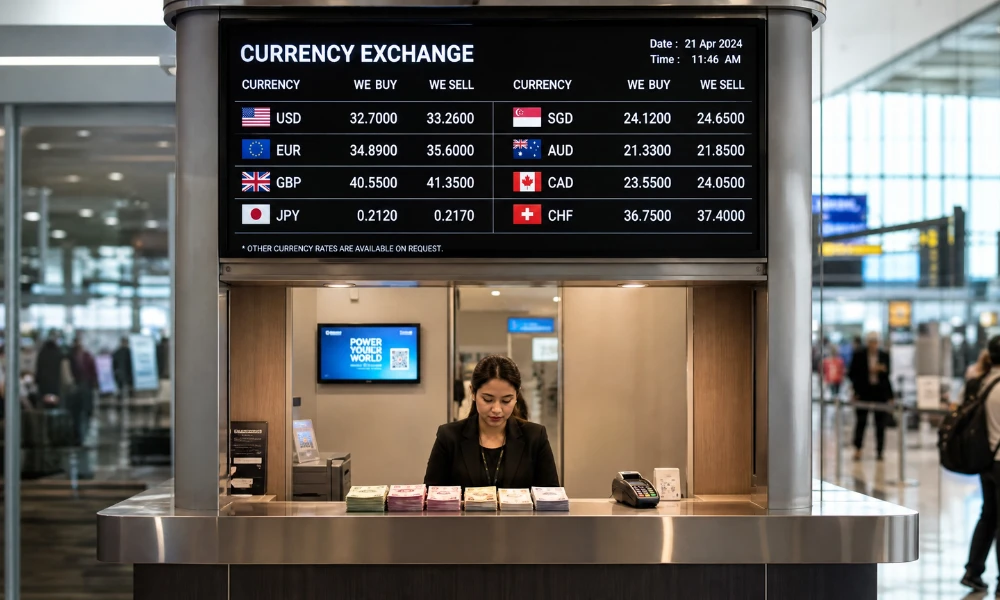
Avoid changing money at the airport
Buying cash at an airport without pre-ordering is often poor value. Airport customers have fewer alternatives at that point, while online pre-order rates can be better. If you know you will need cash, compare and order before reaching the terminal where possible.
If you need cash at short notice, check whether your departure airport allows online pre-order for collection and compare the final amount with other available options before committing at the counter.
Use a card with no foreign transaction fees
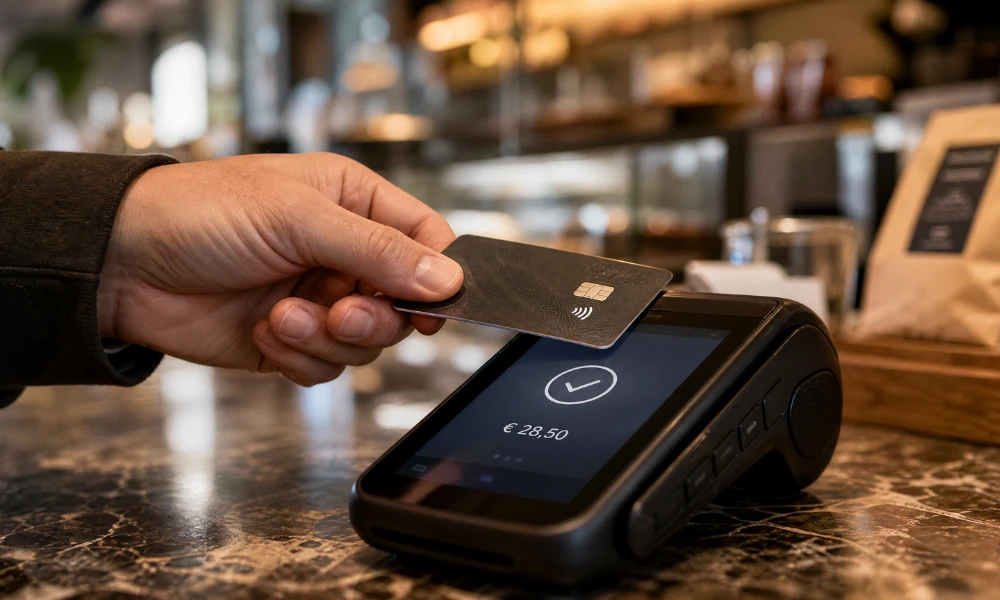
Some UK debit and credit cards charge no foreign-transaction fee on purchases abroad, while others add an exchange-rate loading, a transaction fee or an ATM charge. Check spending and cash-withdrawal fees separately, and check which exchange rate or card-network conversion applies before relying on a card as your cheapest option.
- Check both the spending fee and the cash withdrawal fee separately — some cards waive one but not the other.
- If you use a credit card abroad, paying the balance in full can avoid purchase interest. Cash withdrawals may be treated differently and can attract fees or interest from the withdrawal date, so check the card issuer's overseas and cash-advance terms before using an ATM.
- Keep a backup card or some cash in case your main card is declined, lost or stolen.
Consider a prepaid travel money card
Prepaid and multi-currency travel cards can help with budgeting, but they do not all convert money in the same way. Some let you exchange pounds into a foreign-currency balance in advance, which fixes the conversion rate for that amount; others convert when you spend. Check when conversion happens, which rate is used, and any top-up, ATM, inactivity or unsupported-currency fees.
- A cross-border fee may apply if you use the card somewhere its loaded currency isn't the local one.
- Inactivity or dormancy fees can apply if there's a balance left unused for a long period.
- Some prepaid cards can also have restrictions on offline or pre-authorised transactions, including certain hotel or car-hire deposits. Check the card's terms if you expect to use it for deposits or security holds rather than ordinary purchases.
Watch out for commission, delivery fees and dynamic currency conversion
“0% commission” marketing sounds appealing, but a provider can still build its margin into a less generous exchange rate, so it's worth comparing the final amount of currency you'll receive rather than the commission structure alone. Low-value orders often attract a delivery charge too, which narrows the gap between a cheap and an expensive provider.
Abroad, a card terminal or ATM may offer to convert the transaction into pounds instead of charging the local currency. This is dynamic currency conversion, where the merchant or ATM operator sets the conversion. If your card offers competitive overseas conversion, choosing the local currency will usually avoid that extra conversion layer; always read the rate and any fees shown on screen before confirming.
A mix of cash and card usually works best
Cash is still useful for tipping, markets, small vendors and places where card acceptance is patchy, but carrying a large amount increases the impact of loss or theft. Travel-insurance cash limits vary by policy and may be lower than the amount you carry. A modest cash reserve plus a primary card and a separate backup payment method is usually more resilient than relying on one option.
When should you buy your travel money?
Ordering cash online in advance can be better value than turning up at an airport counter, but there is no reliable way to predict the single best exchange-rate day. If departure is close, our passport renewal guide is also worth checking. Buyback guarantees can be useful for leftovers, but check the buyback rate and conditions because they may be less favourable than your original purchase rate.
Already sorted your travel money? Make sure the flight itself doesn't cost you too
Getting a good rate on holiday money only helps if the journey runs as planned. If a qualifying flight is delayed, cancelled or you are denied boarding, UK261 may provide fixed compensation, including up to £520 in some circumstances. Eligibility depends on the route, disruption and cause; use our compensation calculator for an estimate or read the UK261 guide before assuming a payment is due.
Frequently asked questions
Is it cheaper to buy travel money online or at a bureau in person?
Online ordering can be better value than buying cash in person without pre-ordering, especially at an airport, but compare the final amount after collection or delivery charges. Exchange rates change, so check the live quote immediately before buying.
Can I use a credit card to buy travel money?
Some travel-money providers accept credit cards, but your card issuer may treat the purchase as a cash transaction. That can trigger a cash-advance fee or immediate interest. Check both the travel-money provider's payment options and your card issuer's terms; debit card or bank transfer may be cheaper, but not in every case.
What's the safest way to carry money abroad?
Spreading your funds across a fee-free card, a smaller amount of local cash and a backup card or prepaid card reduces the impact if one is lost, stolen or declined. Avoid carrying more cash than you'd be comfortable losing.
Had a flight disrupted in the last six years? Check Your Flight to see if you're owed compensation. For common eligibility questions, see our flight delay FAQs. Claims are fact-specific and compensation is not automatic.
claim now
Have you had a flight delay, missed connection, cancelled flight or have been denied boarding in the last 6 years? If so try our free flight checker to see how much you may be entitled to in compensation for you AND your fellow travellers.
Start a Claim