- Home
- Make a claim
- Airlines
- Adria Airways
- Aegean Airlines
- Aer Lingus
- Aeroflot Russian Airlines
- AeroMexico
- Air Albania
- Air Algerie
- Air Arabia
- Air Austral
- Air Baltic
- Air Canada
- Air China
- Air Corsica
- Air Dolomiti
- Air Europa
- Air France
- Air India
- Air Malta
- Air Mauritius
- Air Moldova
- Air New Zealand
- Air Philippines
- Air Senegal International
- Air Serbia
- Air Transat
- Alitalia Express
- All Nippon Airways
- American Airlines
- Arkia Israel Airlines
- ASL Airlines
- Atlantic Airways
- Aurigny Air Services
- Austrian Airlines
- Avianca
- Azerbaijan Airlines
- Azores - SATA International
- Biman Bangladesh Airlines
- Blue Air
- Blue Islands
- Bluebird Airways
- BMI Regional
- British Airways
- Brussels Airlines
- Brussels International Airlines
- Bulgaria Air
- Buzz Stansted
- Cathay Pacific
- China Airlines
- China Eastern Airlines
- Continental Airlines
- Corendon Airlines
- Croatia Airlines
- Cyprus Airways
- Czech Airlines
- Delta Air Lines
- Eastern Airways
- easyJet
- Egyptair
- El Al
- Emirates
- Envoy Air
- Ethiopian Airlines
- Etihad Airways
- Eurowings
- Finnair
- Fly One
- Flybe
- Flyr
- Gol Transportes Areos
- Gulf Air
- Helvetic Airways
- HiSky
- Iberia Airlines
- Iberia Express
- Icelandair
- Iran Air
- Iraqi Airways
- ITA Airways
- Japan Airlines
- Jazeera Airways
- Jet Airways
- Jet2
- JetBlue
- Juneyao Air
- Kenya Airways
- KLM
- Korean Air
- Kuwait Airways
- LATAM Airlines
- Lauda Europe
- Loganair
- LOT Polish Airlines
- Lufthansa
- Luxair
- Malaysia Airlines
- Norse
- Norwegian
- Nouvelair Tunisie
- Pakistan International Airlines
- Pegasus Airlines
- Play Airlines
- Qantas
- Qatar Airways
- Riyadh Air
- Rossiya Russian Airlines
- Royal Air Maroc
- Ryanair
- SAS
- Saudia
- Scoot
- Silk Way Airlines
- Singapore Airlines
- Sky Express
- South African Airways
- SriLankan Airlines
- SunExpress
- Sunwing Airlines
- Surinam Airways
- Swiss International
- TAP Air Portugal
- Thai Airways
- Transavia
- TUI
- Tunisair
- Turkish Airlines
- Turkmenistan Airlines
- Ukraine International Airlines
- Vietnam Airlines
- Virgin Atlantic
- Vueling Airlines
- WestJet
- Wideroe
- Wizz Air
- Airports
- FAQ's
- Compensation Calculator
- Recent Flight Delays
- Blog
- About Us
- Contact Us
Travel insurance vs EC261 compensation: do you need both?
Date: 08 JUNE 26
When a flight goes wrong, most passengers instinctively reach for their travel insurance policy. But the question of travel insurance vs EC261 compensation is one that trips up even experienced travellers — and getting it wrong can mean leaving real money on the table.
These are two completely separate protections. They exist for different reasons, cover different things, and are claimed through different channels. In many situations, you are actually entitled to use both — and doing so is entirely legal and straightforward.
This guide cuts through the confusion and explains exactly how each works, when one is better than the other, and when pursuing both is the right approach.
What is EC261 compensation?
EC261 — formally known as EC Regulation 261/2004, and retained in UK law as UK261 — is a piece of legislation that gives air passengers a legal right to fixed compensation when their flight is delayed, cancelled, or they are denied boarding. It has nothing to do with insurance. It is a statutory right that exists independently of anything you purchased.
EC261 passenger rights entitle you to a fixed cash payment from the airline itself, based on the distance of your flight. The amounts are:
• £220 per person for flights under 1,500km
• £350 per person for flights between 1,500km and 3,500km
• £260 per person for long-haul flights (over 3,500km) arriving 3 to 4 hours late
• £520 per person for long-haul flights arriving more than 4 hours late
These are flat amounts — they bear no relation to the price you paid for your ticket. A passenger on a £30 Ryanair flight is entitled to the same compensation as one who paid £500 for a business class seat on the same route.
The one major exception is extraordinary circumstances — situations genuinely outside the airline's control, such as extreme weather events or air traffic control strikes. When an airline can prove an extraordinary circumstance caused the delay, it is not required to pay EC261 compensation. However, even in these situations, it must still provide care: food, drinks, accommodation if overnight, and a way to communicate.
What does travel insurance cover for flight disruption?
Travel insurance typically offers a different kind of protection. Rather than paying a fixed statutory amount, it reimburses you for actual financial losses caused by disruption — up to the limits of your policy.
Cover varies between policies and providers, but most travel insurance policies for flight disruption will include some combination of:
• Delay payouts — a fixed amount per hour of delay, typically kicking in after a set threshold (commonly two or four hours)
• Missed departure cover — costs incurred if you miss your flight due to a reason outside your control, such as a transport breakdown getting to the airport
• Cancellation cover — reimbursement for the cost of your trip if you are forced to cancel due to illness, bereavement, or other specified events
• Curtailment cover — if you have to cut your trip short for a covered reason
• Out-of-pocket expenses — meals, accommodation and transport costs caused by disruption not covered elsewhere
Critically, travel insurance covers a much broader range of events than EC261 passenger rights. If your flight is delayed because you fell ill at the airport, your insurer may pay out even though no EC261 claim is possible. If your luggage is stolen or you need emergency medical treatment abroad, insurance is your only source of protection.
Travel insurance vs EC261 compensation: the key differences
Here is a side-by-side comparison of how the two protections work:
| Factor | Travel insurance | EC261 compensation |
|---|---|---|
| Cost | You pay a premium upfront | Free — no premium required |
| Scope | Broad (illness, baggage, cancellation, medical) | Flights only (delay, cancellation, denied boarding) |
| Payout type | Reimburses your actual losses | Fixed statutory amount per person |
| Who pays | Your insurer | The airline directly |
| Waiting time | Claim processed by insurer (days–weeks) | Can take weeks to months |
| Requires fault? | No — covers many events regardless of cause | Yes — airline must be responsible (not extraordinary circumstances) |
| Can you claim both? | Yes, for different losses | Yes, alongside insurance for non-overlapping costs |
The most important thing to notice in that comparison is the final row. You can claim both — and in many delay situations, doing so makes complete sense. EC261 pays you a flat statutory sum for the disruption itself. Travel insurance can then reimburse specific out-of-pocket costs on top of that, provided they are covered under your policy and are not already being compensated through EC261.
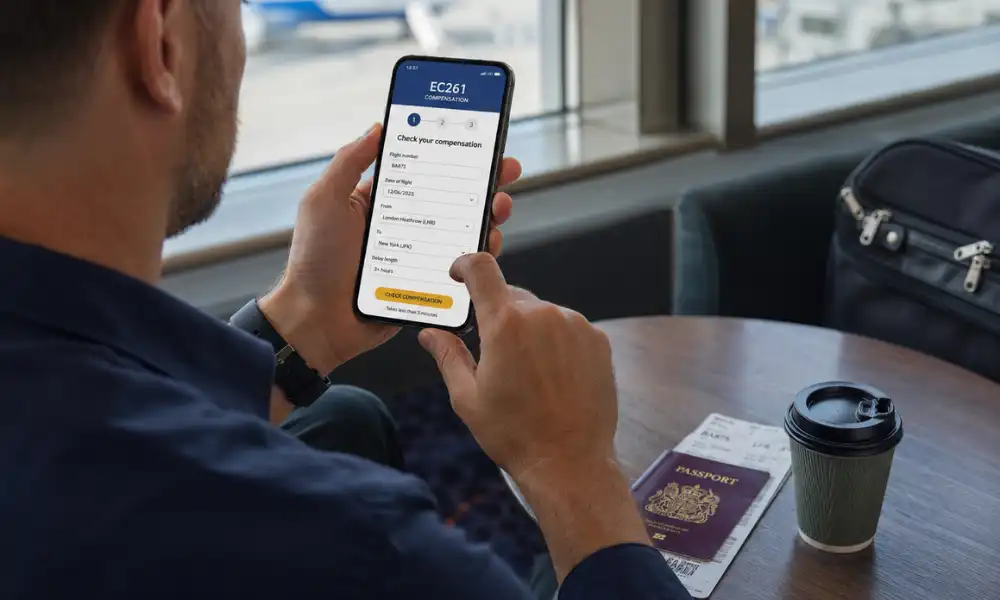
Not sure whether your delayed or cancelled flight qualifies for EC261 compensation?
EC261 applies to most flights departing from UK or EU airports, and to UK and EU carriers on inbound routes. Checking whether your flight qualifies takes minutes. Use our free compensation checker to see what you may be owed — there is no obligation and no upfront cost.
When EC261 compensation is the better option
EC261 flight delay compensation is almost always the more valuable protection for straightforward flight delays and cancellations — provided the airline is at fault and the route qualifies.
The reason is simple: the fixed amounts are substantial. Up to £520 per person is a meaningful sum, regardless of what you actually spent during the delay. A family of four on a long-haul flight that arrives five hours late could be entitled to over £2,000 in statutory compensation before a single receipt is produced.
Travel insurance delay payouts, by contrast, tend to be far more modest. Many policies pay £20 to £50 per hour of delay, with a cap of £200 to £300 per person. If you have a strong EC261 claim, your insurance payout for the delay element is likely to be much smaller — and using EC261 first is the obvious priority.
EC261 passenger rights also apply regardless of whether you have insurance at all. You do not need to have taken out a policy to make a claim. Every eligible passenger has this right — including those who booked a free or heavily discounted fare.
To understand the full range of situations covered, our guide to what qualifies as a flight delay claim sets out the eligibility rules in detail.
When travel insurance picks up what EC261 cannot
There are situations where EC261 passenger rights simply do not apply — and this is where travel insurance earns its place.
Extraordinary circumstances
If your delay or cancellation was caused by genuine extraordinary circumstances — a severe storm closing the airport, a volcanic ash cloud, a security threat — the airline is not liable to pay EC261 compensation. Your travel insurance may still pay out for your delay costs, provided the event is covered under your policy. Check the exclusions carefully, as some policies carve out certain weather events or political situations.
Flights outside EC261 coverage
EC261 applies to flights departing from UK or EU airports, and to UK and EU airlines flying into these airports. If you are flying on a non-EU airline from a non-EU destination — for example, a US carrier from New York to London — EC261 does not apply on the outbound journey. Travel insurance provides cover where the regulation falls short.
Cancellations before travel
If you decide to cancel your own trip due to illness, a family emergency, or another covered event, EC261 has nothing to offer you — it only applies to airline-initiated disruption. Travel insurance cancellation cover is the only protection in these scenarios.
Medical and personal emergencies
Any medical emergency abroad, lost or stolen belongings, or personal accident falls entirely outside EC261. These are insurance-only risks, and they are arguably the most important reason to take out travel cover for any significant trip.
Can you claim both travel insurance and EC261 compensation at the same time?
Yes — and if you have both available, you often should. They are not mutually exclusive and claiming one does not affect your right to the other.
The practical way to approach it is to separate the claims into distinct categories:
• EC261 compensation: claim the flat statutory payment from the airline for the delay or cancellation itself. This is a legal entitlement — it is not a reimbursement for specific costs.
• Travel insurance: claim for specific out-of-pocket expenses not covered by EC261 — meals you had to buy if no vouchers were provided, accommodation costs that exceeded what the airline arranged, or additional transport costs. Check whether your insurer requires you to pursue EC261 first.
One thing to be aware of: insurers typically apply a principle of not allowing double recovery. If EC261 already covers a cost, you generally cannot also claim that exact same cost through insurance. However, there is no rule preventing you from receiving EC261 compensation for the delay itself and then separately recovering genuine out-of-pocket expenses that EC261 does not reimburse.
If your flight was cancelled rather than delayed, the same logic applies. Our cancelled flight compensation guide explains how the EC261 rules work differently for cancellations and what you are entitled to claim.
A practical checklist when your flight is disrupted
If your flight is significantly delayed or cancelled, here is a straightforward order of actions to protect your position:
• Get written confirmation from the airline of the delay duration and, if possible, the stated reason.
• Keep all receipts for food, drinks, transport and accommodation you arrange yourself while waiting.
• Note the actual arrival time at your destination — EC261 is based on when you land, not when you depart.
• Check EC261 eligibility first — if the airline is at fault and the route qualifies, this is your primary claim.
• Contact your insurer to report the disruption and ask about policy cover for any additional out-of-pocket costs.
The UK Civil Aviation Authority guidance on passenger rights provides clear official information on what airlines are required to provide and when EC261 applies — worth bookmarking before you travel.
Our flight compensation FAQ covers the most common questions passengers have when deciding whether and how to claim, including how long claims typically take and what happens if an airline disputes your case.
claim now
Have you had a flight delay, missed connection, cancelled flight or have been denied boarding in the last 6 years? If so try our free flight checker to see how much you may be entitled to in compensation for you AND your fellow travellers.
Start a Claim