- Home
- Make a claim
- Airlines
- Adria Airways
- Aegean Airlines
- Aer Lingus
- Aeroflot Russian Airlines
- AeroMexico
- Air Albania
- Air Algerie
- Air Arabia
- Air Austral
- Air Baltic
- Air Canada
- Air China
- Air Corsica
- Air Dolomiti
- Air Europa
- Air France
- Air India
- Air Malta
- Air Mauritius
- Air Moldova
- Air New Zealand
- Air Philippines
- Air Senegal International
- Air Serbia
- Air Transat
- Alitalia Express
- All Nippon Airways
- American Airlines
- Arkia Israel Airlines
- ASL Airlines
- Atlantic Airways
- Aurigny Air Services
- Austrian Airlines
- Avianca
- Azerbaijan Airlines
- Azores - SATA International
- Biman Bangladesh Airlines
- Blue Air
- Blue Islands
- Bluebird Airways
- BMI Regional
- British Airways
- Brussels Airlines
- Brussels International Airlines
- Bulgaria Air
- Buzz Stansted
- Cathay Pacific
- China Airlines
- China Eastern Airlines
- Continental Airlines
- Corendon Airlines
- Croatia Airlines
- Cyprus Airways
- Czech Airlines
- Delta Air Lines
- Eastern Airways
- easyJet
- Egyptair
- El Al
- Emirates
- Envoy Air
- Ethiopian Airlines
- Etihad Airways
- Eurowings
- Finnair
- Fly One
- Flybe
- Flyr
- Gol Transportes Areos
- Gulf Air
- Helvetic Airways
- HiSky
- Iberia Airlines
- Iberia Express
- Icelandair
- Iran Air
- Iraqi Airways
- ITA Airways
- Japan Airlines
- Jazeera Airways
- Jet Airways
- Jet2
- JetBlue
- Juneyao Air
- Kenya Airways
- KLM
- Korean Air
- Kuwait Airways
- LATAM Airlines
- Lauda Europe
- Loganair
- LOT Polish Airlines
- Lufthansa
- Luxair
- Malaysia Airlines
- Norse
- Norwegian
- Nouvelair Tunisie
- Pakistan International Airlines
- Pegasus Airlines
- Play Airlines
- Qantas
- Qatar Airways
- Rossiya Russian Airlines
- Royal Air Maroc
- Ryanair
- SAS
- Saudia
- Scoot
- Silk Way Airlines
- Singapore Airlines
- Sky Express
- South African Airways
- SriLankan Airlines
- SunExpress
- Sunwing Airlines
- Surinam Airways
- Swiss International
- TAP Air Portugal
- Thai Airways
- Transavia
- TUI
- Tunisair
- Turkish Airlines
- Turkmenistan Airlines
- Ukraine International Airlines
- Vietnam Airlines
- Virgin Atlantic
- Vueling Airlines
- WestJet
- Wideroe
- Wizz Air
- Airports
- FAQ's
- Compensation Calculator
- Recent Flight Delays
- Blog
- About Us
- Contact Us
Refund vs compensation: what is the difference and can you claim both?
Date: 30 MAR 26
When a flight goes wrong, most passengers know they are entitled to something — but far fewer know exactly what. Flight refund and compensation are two separate legal rights under UK law, and they work in completely different ways. Mixing them up is one of the most common mistakes passengers make, and it can result in accepting far less than you are actually owed.
This guide explains the difference clearly, covers when airline passenger rights entitle you to each, and — crucially — answers the question most passengers never think to ask: can you claim both at the same time? The answer is yes, in many situations. But the rules that govern refunds and compensation are separate, and understanding them separately is what allows you to claim everything you are entitled to.
What is a flight refund?
A refund is exactly what it sounds like: a return of the money you paid for your flight ticket. It is not a reward or a penalty — it is simply the airline giving back money for a service you did not receive.
Under UK law — which mirrors the protections in EU Regulation EC 261/2004 — you are entitled to a flight refund if your flight was cancelled, if it was delayed by more than five hours and you chose not to travel, or if you were denied boarding and did not wish to accept an alternative flight. In each of these cases, the airline must refund you the full cost of your unused ticket, including all taxes and charges, within seven days.
The refund must be paid in cash or by bank transfer. An airline can offer you a travel voucher instead, but only if you agree to it — and you are never obliged to accept one. If you would prefer the money back, you are entitled to insist on it. Always check what you are signing before accepting any alternative form of reimbursement.
One important point about refunds: they are owed regardless of the reason the flight was disrupted. Whether the cancellation was caused by a technical fault, a strike, or severe weather, your right to a refund of your unused ticket remains. This is a fundamental part of your airline passenger rights, and it applies in all circumstances.
What is flight delay compensation?
Compensation is a different and separate right. Where a refund returns money you have already paid, flight delay compensation UK law provides is additional money — a fixed sum paid to you because the disruption caused you inconvenience, regardless of what your ticket cost.
Under UK 261 — the retained version of EU Regulation EC 261/2004 that continues to apply in the UK following Brexit — you are entitled to flight delay compensation UK airlines must pay if your flight arrived at its destination more than three hours late, was cancelled with less than 14 days' notice, or if you were denied boarding due to overbooking. The compensation is fixed by law and has nothing to do with the price you paid for your ticket.
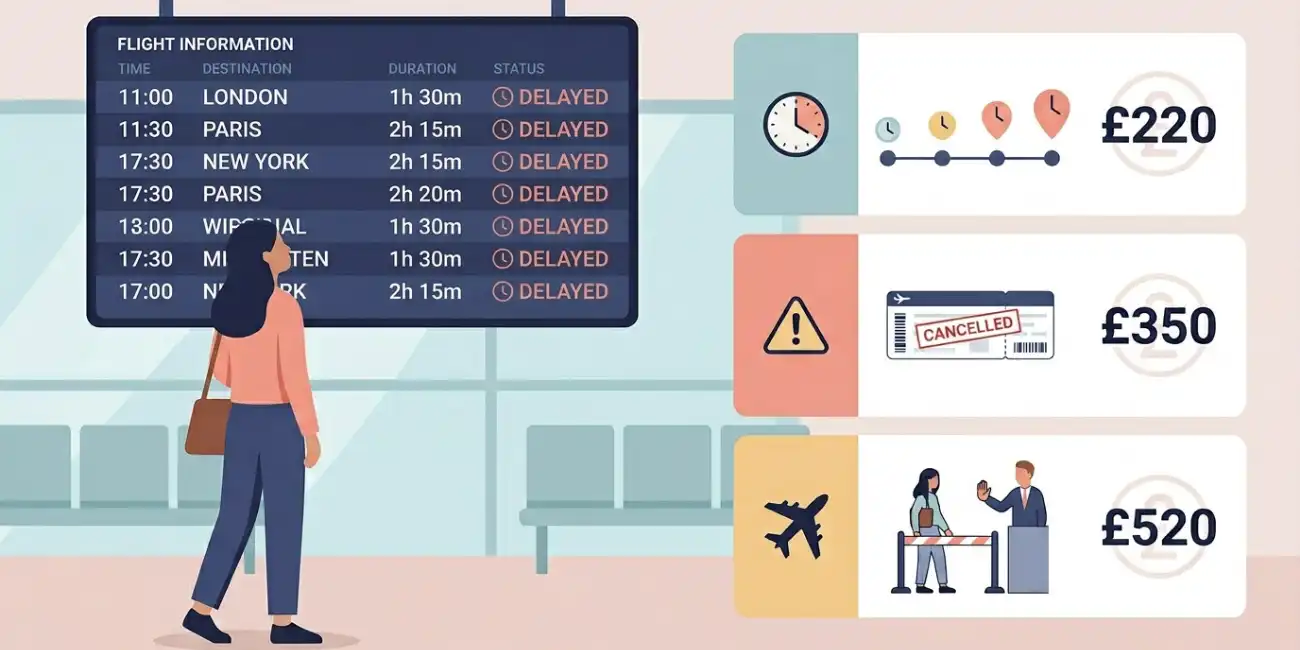
The amounts are:
- £220 for flights of 1,500km or less
- £350 for flights between 1,500km and 3,500km
- £520 for flights over 3,500km
These figures apply to flights departing from a UK airport, or flights arriving in the UK on a UK or EU carrier. If you are unsure whether your specific flight qualifies, our flight compensation calculator works out your entitlement based on your route and delay length in a matter of seconds.
The key difference between a flight refund and compensation
The simplest way to understand the distinction is this:
- A refund aims to return the money you paid. It reverses the transaction because the service you bought was not delivered.
- Compensation is a fixed penalty the airline pays you for the inconvenience caused. It is not connected to what you paid — it is connected to how severely you were disrupted.
A passenger who paid £89 for a budget flight and a passenger who paid £650 for a flexible fare on the same route are entitled to exactly the same amount of compensation if the flight is delayed by the same number of hours. That is by design — compensation is not about the price of your ticket.
The other critical difference relates to extraordinary circumstances. Your airline passenger rights to a refund hold firm regardless of why the flight was disrupted. But compensation is not owed when the disruption was caused by something genuinely outside the airline's control — a severe storm, airspace closures, political instability, or an air traffic control strike, for example. If the cause falls within the airline's control — a technical fault, operational issues, staffing problems — compensation is owed.
Here is a side-by-side summary:
| Refund | Compensation | |
|---|---|---|
| What it is | Return of money paid for an unused flight | Fixed payment for inconvenience caused by a disruption |
| Trigger | Cancellation, 5+ hour delay, denied boarding | Cancellation under 14 days' notice, 3+ hour delay, denied boarding due to overbooking |
| Amount | Full or partial ticket price (plus taxes) | £220–£520 depending on flight distance |
| Extraordinary circumstances? | Still owed — always | Not owed — airline is exempt |
| Can you claim both? | Yes | Yes — they are independent rights |
Can you claim flight refund and compensation at the same time?
Yes — and this is the part most passengers do not realise. Flight refund and compensation are regulated independently of each other. Receiving one does not cancel out your entitlement to the other. They are assessed separately, governed by different rules, and can both be claimed in the same situation.
The clearest example is a cancelled flight. If your airline cancels your flight with less than 14 days' notice, you are entitled to a full refund of your ticket and compensation for the disruption — provided the cancellation was not caused by extraordinary circumstances. These are two distinct legal rights, and you can pursue both simultaneously.
Similarly, if your flight is significantly delayed — say by four hours on a route over 1,500km — and you chose to travel anyway, you are not entitled to a refund (you used the service), but you are still entitled to flight delay compensation UK law provides. In this case, you get compensation but no refund. If the delay exceeded five hours and you decided not to travel at all, you could claim both the refund and the compensation.
When you can claim both
- Your flight was cancelled fewer than 14 days before departure, for reasons within the airline's control, and you opted for a refund rather than rebooking
- Your flight was delayed by more than five hours, you decided not to travel, and the delay was caused by something within the airline's control
- You were denied boarding due to overbooking and did not accept an alternative flight
When you can only claim compensation, not a refund
- Your flight was delayed by three to five hours and you chose to travel — you are owed compensation but not a refund, because you used the service
- Your flight was significantly delayed, you accepted a rebooked flight, and you arrived at your destination more than three hours late — compensation applies; the ticket itself was used
When you can only claim a refund, not compensation
- Your flight was cancelled due to extraordinary circumstances — a storm, airspace closure, or strike outside the airline's control — and you chose not to travel. The refund is owed; compensation is not.
- Your flight was delayed by more than five hours due to extraordinary circumstances and you decided not to travel. Again, refund yes, compensation no.
Extraordinary circumstances: what they mean for your airline passenger rights
Extraordinary circumstances are the most common reason airlines use to avoid paying compensation — not a refund, which is always owed, but the fixed compensation sum. The concept refers to situations that are genuinely outside the airline's control and which could not have been avoided even if every reasonable measure had been taken.
Examples that are generally accepted as extraordinary circumstances include:
- Severe weather that makes it unsafe to operate the flight
- Air traffic control strikes or airspace closures
- Political unrest or security threats at the destination
- Natural disasters or unexpected runway closures
Examples that are generally not accepted as extraordinary circumstances — and which therefore do not exempt the airline from paying compensation — include:
- Technical faults discovered during maintenance (these are within the airline's operational control)
- Crew shortages due to internal scheduling issues
- Overbooking — which is always a commercial decision made by the airline
Airlines sometimes claim extraordinary circumstances when the disruption was actually within their control. If you are told that compensation is not owed due to extraordinary circumstances but you are not convinced the reason given qualifies, it is always worth pursuing the claim. Your airline passenger rights in this area are well established, and a successful challenge is common.
What about vouchers? Do they affect your flight delay compensation claim?
This is an area where many passengers inadvertently give up their rights. If your flight is cancelled and the airline offers you a travel voucher, accepting it in place of a cash refund does not remove your entitlement to flight refund and compensation separately. Your right to compensation is a separate legal matter and is not resolved by accepting a voucher for future travel.
However, some airlines present vouchers in a way that implies they cover everything — refund and compensation in one. Always read any document you are asked to sign carefully. If you are accepting a voucher as your refund, make sure it is clear that you are still reserving the right to claim flight delay compensation UK law entitles you to through a separate process.
The safest approach is to request a cash refund rather than a voucher unless you are certain the voucher value reflects both your ticket cost and your full compensation entitlement — which is rare.
How to claim your flight refund and compensation
Both claims can be submitted to the airline directly, but the process and timescales differ. Refunds should be processed within seven days of your request. Compensation claims can take longer — airlines sometimes respond slowly, dispute eligibility, or fail to respond at all, which is where professional support makes a real difference.
To support your flight refund and compensation claim, it helps to keep your boarding pass, booking confirmation, any delay notifications from the airline, and receipts for additional expenses incurred as a result of the disruption. If you were made to wait at the airport, the airline should also have provided meals, refreshments, and where applicable, accommodation — these rights exist alongside your refund and compensation entitlement and do not affect them. If you are unsure about your airline passenger rights or need help submitting a claim, get in touch with our team and we will assess your case and handle the process from start to finish — with no upfront fees.
claim now
Have you had a flight delay, missed connection, cancelled flight or have been denied boarding in the last 6 years? If so try our free flight checker to see how much you may be entitled to in compensation for you AND your fellow travellers.
Start a Claim