- Home
- Make a claim
- Airlines
- Adria Airways
- Aegean Airlines
- Aer Lingus
- Aeroflot Russian Airlines
- AeroMexico
- Air Albania
- Air Algerie
- Air Arabia
- Air Austral
- Air Baltic
- Air Canada
- Air China
- Air Corsica
- Air Dolomiti
- Air Europa
- Air France
- Air India
- Air Malta
- Air Mauritius
- Air Moldova
- Air New Zealand
- Air Philippines
- Air Senegal International
- Air Serbia
- Air Transat
- Alitalia Express
- All Nippon Airways
- American Airlines
- Arkia Israel Airlines
- ASL Airlines
- Atlantic Airways
- Aurigny Air Services
- Austrian Airlines
- Avianca
- Azerbaijan Airlines
- Azores - SATA International
- Biman Bangladesh Airlines
- Blue Air
- Blue Islands
- Bluebird Airways
- BMI Regional
- British Airways
- Brussels Airlines
- Brussels International Airlines
- Bulgaria Air
- Buzz Stansted
- Cathay Pacific
- China Airlines
- China Eastern Airlines
- Continental Airlines
- Corendon Airlines
- Croatia Airlines
- Cyprus Airways
- Czech Airlines
- Delta Air Lines
- Eastern Airways
- easyJet
- Egyptair
- El Al
- Emirates
- Envoy Air
- Ethiopian Airlines
- Etihad Airways
- Eurowings
- Finnair
- Fly One
- Flybe
- Flyr
- Gol Transportes Areos
- Gulf Air
- Helvetic Airways
- HiSky
- Iberia Airlines
- Iberia Express
- Icelandair
- Iran Air
- Iraqi Airways
- ITA Airways
- Japan Airlines
- Jazeera Airways
- Jet Airways
- Jet2
- JetBlue
- Juneyao Air
- Kenya Airways
- KLM
- Korean Air
- Kuwait Airways
- LATAM Airlines
- Lauda Europe
- Loganair
- LOT Polish Airlines
- Lufthansa
- Luxair
- Malaysia Airlines
- Norse
- Norwegian
- Nouvelair Tunisie
- Pakistan International Airlines
- Pegasus Airlines
- Play Airlines
- Qantas
- Qatar Airways
- Riyadh Air
- Rossiya Russian Airlines
- Royal Air Maroc
- Ryanair
- SAS
- Saudia
- Scoot
- Silk Way Airlines
- Singapore Airlines
- Sky Express
- South African Airways
- SriLankan Airlines
- SunExpress
- Sunwing Airlines
- Surinam Airways
- Swiss International
- TAP Air Portugal
- Thai Airways
- Transavia
- TUI
- Tunisair
- Turkish Airlines
- Turkmenistan Airlines
- Ukraine International Airlines
- Vietnam Airlines
- Virgin Atlantic
- Vueling Airlines
- WestJet
- Wideroe
- Wizz Air
- Airports
- FAQ's
- Compensation Calculator
- Recent Flight Delays
- Blog
- About Us
- Contact Us
Monzo vs Revolut: which is the best credit card to use abroad?
Date: 01 JUNE 26
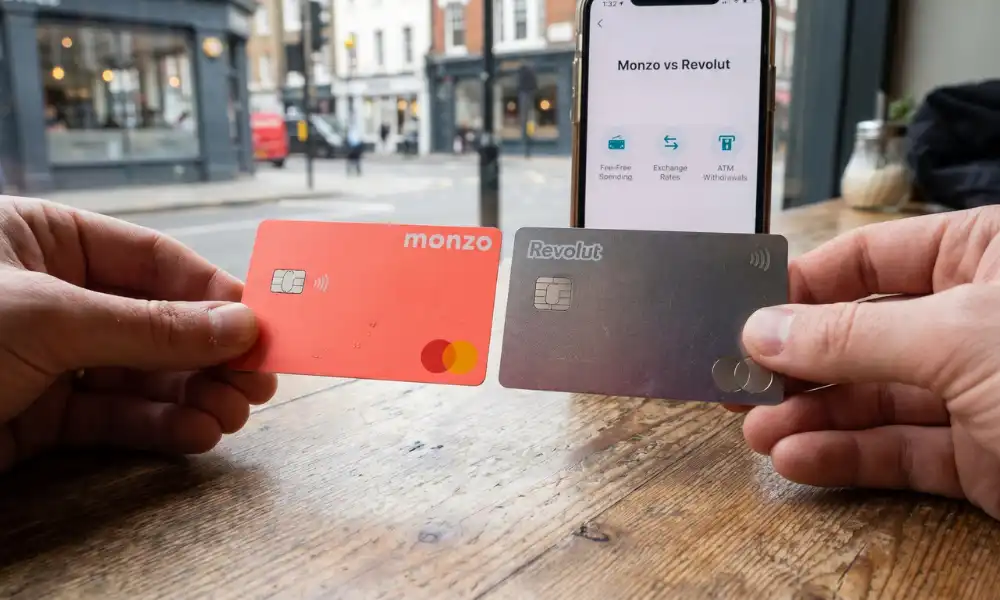
Monzo vs Revolut abroad is one of the most-searched travel money questions in the UK — and for good reason. Both are digital banks offering fee-free overseas spending, competitive exchange rates, and slick app experiences. But they work differently, and choosing the wrong one could mean paying avoidable fees every time you tap your card at a restaurant, hotel, or ATM on holiday.
This guide breaks down exactly how each card performs abroad, where the fees hide, and which type of traveller each one suits best. Whether you're heading to Europe for a long weekend or spending months travelling further afield, knowing which is the best credit card to use abroad for your needs will save you real money.
Monzo vs Revolut abroad: the quick verdict
If you want a simple, no-fuss travel money card UK option and you already bank with Monzo as your main account, Monzo is the more straightforward choice. It uses Mastercard exchange rates with zero fees on spending abroad, and there are no weekend surcharges — you pay the same rate whether you're shopping on a Tuesday or a Saturday.
Revolut, on the other hand, offers more flexibility and a wider range of tools — but its free plan comes with a weekend fee on currency exchange that catches many travellers out. For frequent or high-spending travellers, Revolut's paid plans unlock better limits and perks that can make it the better option overall.
The bottom line: Monzo wins for simplicity; Revolut wins for high-volume or frequent travellers who get value from its premium plans.
Monzo vs Revolut abroad: feature comparison at a glance
| Feature | Monzo (Free plan) | Revolut (Free plan) |
|---|---|---|
| Overseas spending fees | None (Mastercard rate) | None on weekdays; weekend surcharge applies |
| ATM withdrawals abroad | Fee-free up to £200/month, then 3% | Fee-free up to £200/month, then 2% |
| ATM limit (EEA, Standard) | £200/month fee-free | £400/month fee-free (UK & EEA) |
| Exchange rate used | Mastercard exchange rate | Interbank rate (weekdays); +1% at weekends |
| FSCS protection | Yes — up to £85,000 | No (funds safeguarded, not FSCS-protected) |
| Savings rate | 3.25% AER (Instant Access) | Varies by plan; interest paid daily |
| Overdraft | Available (19–39% EAR) | Not available (not fully UK-licensed) |
| Paid plans available | Yes (Plus, Premium) | Yes (Extra, Perks, Max — from £3.99/month) |
Exchange rates: which gives you more for your money abroad?
Exchange rates are where the real difference between Monzo and Revolut becomes clear when using your travel money card UK.
Monzo uses the Mastercard exchange rate, which is updated throughout the day and consistently tracks close to the interbank rate. Crucially, Monzo applies this rate seven days a week with no markup. You spend £100, you get £100 worth of foreign currency at the current Mastercard rate — every time, without exception.
Revolut uses the interbank rate on weekdays, which is typically fractionally better than the Mastercard rate. However, on Saturdays and Sundays, Revolut applies a 1% weekend surcharge (higher on some currencies) because currency markets are closed and Revolut hedges against rate movements. For travellers who do most of their spending on weekend trips — city breaks, short-haul holidays, ski trips — this is worth factoring into any Monzo vs Revolut abroad comparison.
Verdict: for pure exchange rate consistency, Monzo edges ahead because its rate is predictable every day of the week. Revolut offers a marginally better weekday rate but disadvantages weekend spenders on its free plan.
ATM withdrawals abroad: limits and fees compared
Both Monzo and Revolut offer fee-free ATM withdrawals abroad up to a monthly limit, after which charges apply. The limits differ by plan, and it's worth knowing exactly where each one stands before you rely on either as your main travel money card UK.
Monzo ATM limits abroad
- Free plan: up to £200 per month fee-free, then 3% on withdrawals above that
- Plus/Premium plans: higher limits apply — check the Monzo app for current thresholds
- Applies to all countries outside the UK
Revolut ATM limits abroad
- Standard plan: fee-free up to £400 per month within the UK and EEA, £200 outside the EEA, then 2% above the limit
- Extra, Perks and Max plans: significantly higher free ATM limits
- Third-party ATM operator charges may still apply regardless of Revolut's own fee policy
Verdict: Revolut's free plan gives a higher ATM allowance within the EEA (£400 vs £200), and its 2% overage fee is lower than Monzo's 3%. If cash withdrawals are important to you on holiday, Revolut's free plan has the edge here.
Day-to-day spending abroad: which card is better?
For straightforward card payments — restaurants, shops, hotels, supermarkets — both Monzo and Revolut are excellent choices when looking for the best credit card to use abroad. Neither charges a foreign transaction fee on standard purchases on their free plans, which immediately puts them ahead of most traditional UK banks and credit cards.
The practical difference comes down to the weekend rate issue with Revolut described above, and how each app handles the experience of spending overseas. Monzo's app is widely praised for its real-time notifications, instant categorisation of foreign transactions, and clean transaction history. Revolut's app is feature-richer but slightly more complex — it rewards users who engage with its broader ecosystem of tools, from currency exchange to stock trading.
For most casual travellers, Monzo's approach to overseas spending is simpler and more transparent. For users who are already comfortable with Revolut's platform, or who use it across multiple currencies regularly, it remains an excellent travel money card UK option.
Protection and safety: FSCS, insurance and fraud cover
One area where Monzo and Revolut differ significantly is financial protection — and it's worth understanding this before committing to either as your primary travel money card UK.
Monzo is a fully licensed UK bank and is protected by the Financial Services Compensation Scheme (FSCS). This means up to £85,000 of your funds are protected if Monzo were to fail. This gives Monzo a meaningful advantage in terms of financial security for customers keeping larger balances.
Revolut holds a UK banking licence but, as of mid-2025, is not yet operating under full UK banking authorisation for all products. Funds held in Revolut are safeguarded — meaning they are held in segregated accounts at regulated partner banks — but this is not the same as FSCS protection. Funds in Revolut's Savings accounts held with its partner banks may benefit from FSCS protection of up to £85,000, but you should verify the current position in the Revolut app.
Both cards offer strong fraud protection and instant card freezing via their apps, which is particularly useful if a card is lost or stolen abroad. This is a genuine practical advantage both carry over traditional bank cards when travelling.
Should you upgrade to a paid plan for travelling abroad?
Both Monzo and Revolut offer premium plans that significantly improve the overseas travel experience — higher ATM limits, no weekend surcharges (Revolut), travel insurance, and additional perks.
Revolut paid plans
- Extra (£3.99/month): higher ATM limits, priority customer support
- Perks (£7.99/month): Greggs, Railcard and Vue subscriptions, travel insurance, phone insurance
- Max (£14.99/month): highest ATM limits, comprehensive travel and medical insurance, airport lounge access
Monzo paid plans
- Plus (from £5/month): credit tracker, higher interest on savings, no overseas ATM fees on eligible withdrawals
- Premium (from £15/month): metal card, travel insurance, higher savings rates
For the best credit card to use abroad with a paid tier, Revolut's Perks plan at £7.99/month is excellent value if you travel frequently — travel insurance, phone cover, and enhanced limits make it a compelling package. Monzo Premium is similarly strong for travellers who want an all-in-one account with insurance built in.
Tips for using your travel money card UK abroad
Whichever card you take, a few consistent habits will ensure you always get the best deal when spending overseas:
- Always pay in the local currency — never accept the "pay in pounds" option (dynamic currency conversion), as the rate offered will be far worse than your card's own exchange rate
- Check your card's ATM limit before you travel so you know when fees will kick in and can plan cash withdrawals accordingly
- Download your card app before you leave and ensure notifications are enabled — instant alerts for every transaction help you spot fraud immediatel
- If using Revolut, do your currency exchange on a weekday to lock in the interbank rate before your weekend trip
- Carry a backup card — even the best travel money card UK can be declined by certain merchants or ATMs abroad
Planning your trip? Know your flight rights too
Choosing the right travel money card UK is one part of smart travel planning. Another is knowing your rights if something goes wrong at the airport. Under UK261 regulations, passengers whose flights are delayed by more than three hours, cancelled without adequate notice, or who are denied boarding may be entitled to compensation of up to £540. If you've experienced a flight delay on a trip — whether you used Monzo, Revolut, or any other card to pay for it — that entitlement exists regardless of how you booked or paid.
Similarly, if your flight was cancelled and you were given less than 14 days' notice, you could have a valid cancelled flight claim. And if you were refused boarding because of overbooking, a denied boarding claim could put up to £540 back in your pocket — the same pocket your Monzo or Revolut card sits in.
It's worth checking before and after every trip. Many passengers leave compensation unclaimed simply because they don't realise they're entitled to it.
Monzo vs Revolut abroad: our final verdict
Both Monzo and Revolut are genuinely excellent choices as a travel money card UK — far ahead of anything most traditional banks offer. The right choice depends on how you travel and what you value most.
Choose Monzo if you want a straightforward, fee-free card with no hidden weekend charges, FSCS protection, and an account that works seamlessly as your everyday UK bank account. It's the most consistent best credit card to use abroad for people who want simplicity and reliability.
Choose Revolut if you travel frequently, want higher ATM limits on the free plan, use multiple currencies, or are willing to pay for a premium plan that bundles in travel insurance and a richer set of features. For regular travellers, MoneySavingExpert's travel card comparison is also worth consulting for an independent view of the full market, including specialist travel credit cards that may suit certain spending patterns even better.
Either way, taking a dedicated travel money card abroad instead of a standard UK bank debit card will save you money on every trip — and that's the decision that matters most.
Disclaimer: This article is for informational purposes only and reflects product features and rates as of July 2025. Product terms, fees and interest rates are subject to change. Always check the relevant app or website for the most up-to-date information before making financial decisions.
claim now
Have you had a flight delay, missed connection, cancelled flight or have been denied boarding in the last 6 years? If so try our free flight checker to see how much you may be entitled to in compensation for you AND your fellow travellers.
Start a Claim