- Home
- Make a claim
- Airlines
- Adria Airways
- Aegean Airlines
- Aer Lingus
- Aeroflot Russian Airlines
- AeroMexico
- Air Albania
- Air Algerie
- Air Arabia
- Air Austral
- Air Baltic
- Air Canada
- Air China
- Air Corsica
- Air Dolomiti
- Air Europa
- Air France
- Air India
- Air Malta
- Air Mauritius
- Air Moldova
- Air New Zealand
- Air Philippines
- Air Senegal International
- Air Serbia
- Air Transat
- Alitalia Express
- All Nippon Airways
- American Airlines
- Arkia Israel Airlines
- ASL Airlines
- Atlantic Airways
- Aurigny Air Services
- Austrian Airlines
- Avianca
- Azerbaijan Airlines
- Azores - SATA International
- Biman Bangladesh Airlines
- Blue Air
- Blue Islands
- Bluebird Airways
- BMI Regional
- British Airways
- Brussels Airlines
- Brussels International Airlines
- Bulgaria Air
- Buzz Stansted
- Cathay Pacific
- China Airlines
- China Eastern Airlines
- Continental Airlines
- Corendon Airlines
- Croatia Airlines
- Cyprus Airways
- Czech Airlines
- Delta Air Lines
- Eastern Airways
- easyJet
- Egyptair
- El Al
- Emirates
- Envoy Air
- Ethiopian Airlines
- Etihad Airways
- Eurowings
- Finnair
- Fly One
- Flybe
- Flyr
- Gol Transportes Areos
- Gulf Air
- Helvetic Airways
- HiSky
- Iberia Airlines
- Iberia Express
- Icelandair
- Iran Air
- Iraqi Airways
- ITA Airways
- Japan Airlines
- Jazeera Airways
- Jet Airways
- Jet2
- JetBlue
- Juneyao Air
- Kenya Airways
- KLM
- Korean Air
- Kuwait Airways
- LATAM Airlines
- Lauda Europe
- Loganair
- LOT Polish Airlines
- Lufthansa
- Luxair
- Malaysia Airlines
- Norse
- Norwegian
- Nouvelair Tunisie
- Pakistan International Airlines
- Pegasus Airlines
- Play Airlines
- Qantas
- Qatar Airways
- Rossiya Russian Airlines
- Royal Air Maroc
- Ryanair
- SAS
- Saudia
- Scoot
- Silk Way Airlines
- Singapore Airlines
- Sky Express
- South African Airways
- SriLankan Airlines
- SunExpress
- Sunwing Airlines
- Surinam Airways
- Swiss International
- TAP Air Portugal
- Thai Airways
- Transavia
- TUI
- Tunisair
- Turkish Airlines
- Turkmenistan Airlines
- Ukraine International Airlines
- Vietnam Airlines
- Virgin Atlantic
- Vueling Airlines
- WestJet
- Wideroe
- Wizz Air
- Airports
- FAQ's
- Compensation Calculator
- Recent Flight Delays
- Blog
- About Us
- Contact Us
How long does a flight delay claim take to process?
Date: 16 MAR 26
A flight delay claim can be quick in some cases and frustratingly slow in others. For a simple, uncontested case, you might hear back within a few weeks. If the airline disputes liability, says the delay was caused by extraordinary circumstances, or pushes the complaint into an appeal or ADR stage, the process can take months instead. That is why the honest answer is not one fixed number of days, but a range shaped by the airline, the evidence, and whether the claim is straightforward.
Current public guidance supports that wider range. Jet2 says it aims to contact customers within 28 days, while MoneySavingExpert says many claims typically take around 4 to 12 weeks. Some straightforward direct claims are resolved sooner, but more contested claims can drag on well beyond that if the airline rejects the case and it needs to be escalated.
For readers trying to work out whether it is even worth starting, a natural first step is the main flight delay claim page, which sets out the basic eligibility position and how the claim process begins.
The short answer on flight delay claim timing
If you want the simplest version, most flight delay claim cases fall into one of three broad patterns:
-
a clear claim paid quickly within a few weeks
-
a routine claim that takes roughly one to three months
-
a disputed claim that takes several months because it needs escalation
That variation exists because airlines do not all process claims at the same speed, and they do not all agree on liability in the same way. A technical fault might look clear to the passenger but still be challenged by the airline. A weather-related delay may be rejected immediately because it is treated as outside the airline’s control. The more disagreement there is, the longer the delayed flight claim usually takes.
What usually happens after you submit a delayed flight claim
Most claims move through the same broad stages, even if the timings vary.
Stage 1: The claim is submitted
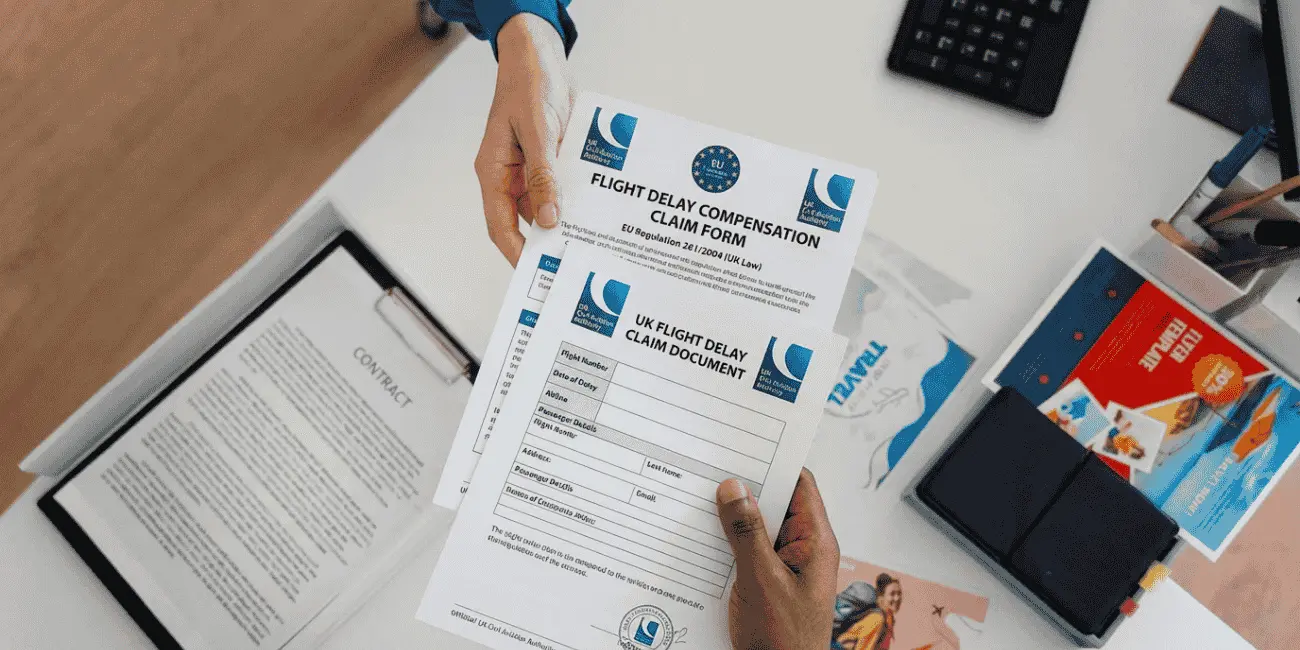
You normally start by submitting the claim directly to the operating airline, not necessarily the company you booked through. The CAA and Citizens Advice both say the first step is to claim from the airline itself and include the key details and supporting information.
This is where a guide on how to claim compensation for a flight delay fits naturally, because getting the basics right at the start can reduce delay later.
Stage 2: The airline reviews the case
At this point, the airline checks whether the flight is covered, whether the arrival delay passed the threshold, and whether the cause was within the airline’s control. Jet2 says it aims to contact customers within 28 days, which gives a useful real-world benchmark even though not every airline works to the same timetable.
Stage 3: The airline accepts, rejects or asks for more information
If the case is straightforward, the airline may accept liability and process payment without much back-and-forth. If not, it may ask for more documents or reject the claim on grounds such as extraordinary circumstances. This is where timelines stretch.
Why some flight delay compensation claims are processed quickly
A flight delay compensation case tends to move faster when the facts are easy to verify. For example, a long delay on a covered route, with a clear arrival time and no obvious extraordinary circumstances, is easier for an airline to process than a complex dispute involving operational explanations or connecting flights. MoneySavingExpert also notes that some direct claims can be resolved surprisingly quickly when the airline accepts the case without argument.
Claims are often quicker when:
-
the flight clearly arrived more than three hours late
-
the route falls obviously within UK or EU rules
-
the disruption appears to have been the airline’s fault
-
the passenger submits complete information at the start
That is also why the compensation calculator is useful in this topic. It helps readers sense-check eligibility and likely value before entering a long claims process.
Why a flight delay claim can take much longer
Not every flight delay claim is simple. Airlines often reject claims by saying the disruption was outside their control. When that happens, the passenger may need to challenge the rejection, provide more evidence, or escalate the complaint. The CAA explains that passengers can take a rejected claim further through ADR or other routes depending on the airline’s arrangements.
The most common reasons for delay include:
-
the airline disputes responsibility
-
the airline says there were extraordinary circumstances
-
the claim involves a cancellation, rerouting or connection issue
-
the passenger submitted incomplete evidence
-
the complaint has to go through ADR or legal escalation
This is why articles such as why flights get delayed and cancelled or delayed flight rights are useful supporting links. They help explain the reasons airlines rely on when deciding whether to pay.
Does a cancelled flight claim take longer than a delayed flight claim?
Sometimes it does. A cancelled flight claim may involve more moving parts because the airline may have offered rerouting, a replacement flight, a refund, or overnight assistance. The compensation position can depend on when the cancellation was announced and how late the replacement service arrived. Citizens Advice explains that cancellation compensation depends not only on the flight distance but also on timing and the replacement offered.
That makes cancellations slightly more complex in some cases than a standard delayed flight claim. If the article is staying tightly on timing, it still makes sense to mention the cancelled flight claim page as a related route for readers whose disruption was not purely a delay.
How long before you should chase the airline?
There is no universal rule that applies to every airline, but if you hear nothing after a few weeks, it is reasonable to follow up. Jet2’s published target of contacting customers within 28 days is a useful benchmark, and MoneySavingExpert’s 4 to 12 week estimate suggests that silence beyond the early part of that window may justify a chase, especially where the claim is clear.
A practical view is:
-
within the first couple of weeks, the claim may simply be in the queue
-
around the one-month point, a follow-up is reasonable if there has been no meaningful update
-
if the airline rejects the claim or leaves it unresolved, the next step may be ADR or another escalation route
What can slow the process down even more?
One of the biggest causes of delay is missing information. If the airline has to ask for the booking reference, proof of travel, receipts or confirmation of disruption details, the claim can stall. Supporting evidence helps the airline assess the claim faster, and it also helps later if the complaint needs to be escalated. The Flight Delay Claim blog also highlights the value of proof and documentation when building a case.
Another delay factor is confusion about who the claim should go to. In some cases, it is the operating airline that matters rather than the brand you booked with. That can slow things down if the claim goes to the wrong place first.
Using pages such as recent flight delays can also help readers check whether the disruption appears on a current delay record, which may strengthen their sense of whether to proceed.
How to make a flight delay claim process faster
You cannot control the airline’s internal queue, but you can reduce avoidable delay.
A faster flight delay claim usually starts with:
-
submitting the claim to the correct operating airline
-
including your booking reference and flight number
-
stating the scheduled and actual arrival issue clearly
-
attaching receipts where you are also reclaiming expenses
-
keeping a copy of everything you send
The clearer the file is at the start, the fewer opportunities there are for the airline to push the claim back for more information.
What happens if the airline rejects the claim?
A rejection does not always mean the end of the process. The CAA says passengers can challenge rejected claims and, depending on the airline, use Alternative Dispute Resolution. ADR is described by the CAA as a simpler and faster alternative to court, though it still adds time to the overall process.
This is the stage where a claim can move from a few weeks into several months. If the airline continues to dispute liability, the timeline stretches because the dispute is no longer just administrative. It becomes a formal disagreement about entitlement.
That is why the article should set expectations honestly. A simple flight delay compensation claim might be paid relatively quickly. A defended case can take much longer.
So, how long does a flight delay claim take to process?
For most readers, the realistic answer is this:
-
some claims are dealt with in a few weeks
-
many routine claims take around 4 to 12 weeks
-
disputed claims can take several months if escalation is needed
That does not mean every long wait is normal. If the airline has gone quiet, rejected the claim without a convincing explanation, or keeps asking for the same information, it may be time to follow up or escalate.
The best way to avoid wasted time is to start with the right facts, the right evidence, and the right route. For readers trying to work out whether they have a valid case before investing that time, the flight delay claim page and the compensation calculator are the strongest first steps. For claims involving more complex disruption, the rights guide on cancelled or delayed flights helps explain where the process becomes more complicated.
A soft closing link can then point readers who want tailored help towards the contact page.
claim now
Have you had a flight delay, missed connection, cancelled flight or have been denied boarding in the last 6 years? If so try our free flight checker to see how much you may be entitled to in compensation for you AND your fellow travellers.
Start a Claim