- Home
- Make a claim
- Airlines
- Adria Airways
- Aegean Airlines
- Aer Lingus
- Aeroflot Russian Airlines
- AeroMexico
- Air Albania
- Air Algerie
- Air Arabia
- Air Austral
- Air Baltic
- Air Canada
- Air China
- Air Corsica
- Air Dolomiti
- Air Europa
- Air France
- Air India
- Air Malta
- Air Mauritius
- Air Moldova
- Air New Zealand
- Air Philippines
- Air Senegal International
- Air Serbia
- Air Transat
- Alitalia Express
- All Nippon Airways
- American Airlines
- Arkia Israel Airlines
- ASL Airlines
- Atlantic Airways
- Aurigny Air Services
- Austrian Airlines
- Avianca
- Azerbaijan Airlines
- Azores - SATA International
- Biman Bangladesh Airlines
- Blue Air
- Blue Islands
- Bluebird Airways
- BMI Regional
- British Airways
- Brussels Airlines
- Brussels International Airlines
- Bulgaria Air
- Buzz Stansted
- Cathay Pacific
- China Airlines
- China Eastern Airlines
- Continental Airlines
- Corendon Airlines
- Croatia Airlines
- Cyprus Airways
- Czech Airlines
- Delta Air Lines
- Eastern Airways
- easyJet
- Egyptair
- El Al
- Emirates
- Envoy Air
- Ethiopian Airlines
- Etihad Airways
- Eurowings
- Finnair
- Fly One
- Flybe
- Flyr
- Gol Transportes Areos
- Gulf Air
- Helvetic Airways
- HiSky
- Iberia Airlines
- Iberia Express
- Icelandair
- Iran Air
- Iraqi Airways
- ITA Airways
- Japan Airlines
- Jazeera Airways
- Jet Airways
- Jet2
- JetBlue
- Juneyao Air
- Kenya Airways
- KLM
- Korean Air
- Kuwait Airways
- LATAM Airlines
- Lauda Europe
- Loganair
- LOT Polish Airlines
- Lufthansa
- Luxair
- Malaysia Airlines
- Norse
- Norwegian
- Nouvelair Tunisie
- Pakistan International Airlines
- Pegasus Airlines
- Play Airlines
- Qantas
- Qatar Airways
- Rossiya Russian Airlines
- Royal Air Maroc
- Ryanair
- SAS
- Saudia
- Scoot
- Silk Way Airlines
- Singapore Airlines
- Sky Express
- South African Airways
- SriLankan Airlines
- SunExpress
- Sunwing Airlines
- Surinam Airways
- Swiss International
- TAP Air Portugal
- Thai Airways
- Transavia
- TUI
- Tunisair
- Turkish Airlines
- Turkmenistan Airlines
- Ukraine International Airlines
- Vietnam Airlines
- Virgin Atlantic
- Vueling Airlines
- WestJet
- Wideroe
- Wizz Air
- Airports
- FAQ's
- Compensation Calculator
- Recent Flight Delays
- Blog
- About Us
- Contact Us
Flight price tracker: the tools that actually tell you when to book
Date: 22 JUNE 26
A good flight price tracker can save you a significant amount of money — but only if you know how to use one. Prices on most routes change dozens of times a day. Book too early and you may overpay. Wait too long and prices shoot up. The tools in this guide are designed to take the guesswork out of when to book flights so you can secure cheap flights without spending hours watching a screen.
This guide covers the best flight price trackers available to UK travellers, how price prediction technology works, when to set alerts versus when to book immediately, and the habits that make the biggest difference to what you actually pay.
Why flight prices change so often
Airlines use a method called yield management to price their seats. It works by continuously adjusting fares based on a range of signals: how quickly seats are selling, what competitors are charging, how many seats remain, the day of the week, upcoming events at the destination, and historical booking patterns for that same route.
Budget airlines in particular reprice their flights multiple times per day. A seat on a Ryanair or easyJet flight may cost £30 on a Tuesday morning and £75 by Friday afternoon — on the exact same route, for the exact same departure. The same dynamic applies to longer-haul carriers, though the swings are often less dramatic on a day-to-day basis.
The result is that there is no single correct time to book flights that applies to every route. What a flight price tracker does is monitor these changes in real time, compare them against historical patterns, and tell you whether the current price is likely to rise, fall, or stay roughly where it is. That information is far more useful than a generic rule like 'book six weeks in advance'.
The best flight price tracker tools for UK travellers
Several tools are worth using together, since they each handle different parts of the tracking and booking journey. Here are the most effective options available to UK-based travellers right now.
Google Flights
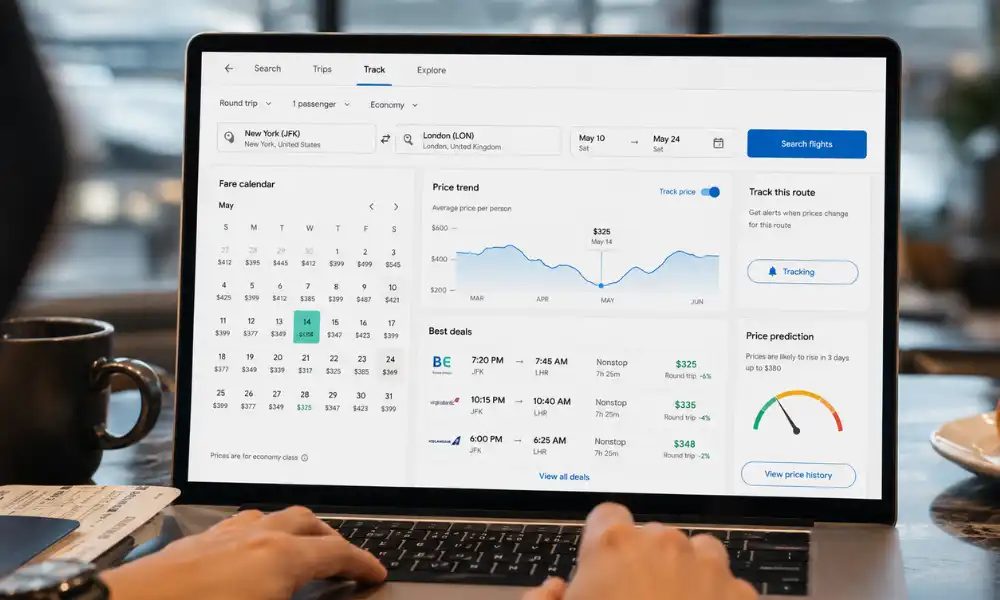
Google Flights is one of the most powerful free tools for monitoring cheap flights. Its calendar view displays prices across an entire month at a glance, so you can immediately see whether your preferred dates are expensive relative to the days around them. The price graph feature extends this across several months, making it especially useful for flexible travellers.
Google Flights also has a price tracking feature that sends email alerts when fares change on a specific route. Once you search for a route, toggle on the 'Track prices' option and you will receive notifications whenever the fare moves in either direction. This works best for routes you are genuinely planning to book, rather than casual browsing.
Skyscanner
Skyscanner's 'Everywhere' search is a powerful starting point if your destination is flexible. Enter your departure airport and set the destination to 'Everywhere', then browse results by cheapest price to find the best value routes available on your preferred dates. This approach regularly surfaces destinations that would not otherwise have crossed your mind.
For specific routes, Skyscanner allows you to set up price alerts and also displays a simple guide showing whether the current price is 'typical', 'cheap', or 'expensive' for that route based on historical data. Its 'Price prediction' feature goes further, indicating whether prices on your route are likely to fall, allowing you to decide whether to book now or wait.
Kayak
Kayak's 'Price forecast' tool analyses price trends and predicts whether fares on your chosen route are likely to rise or drop over the coming days. Unlike some tools that give a vague recommendation, Kayak displays a percentage confidence level alongside its prediction — so you can see how certain the algorithm is about its advice. This is particularly useful when you are on the fence about booking immediately.
Kayak also offers a flexible dates grid that makes it easy to spot cheaper departure and return day combinations, which is one of the most reliable ways to reduce the cost of cheap flights on popular routes.
AirHint
AirHint is a specialist flight price tracker focused on prediction rather than comparison. It uses machine learning trained on historical pricing data for specific airlines — rather than a single generic model — to forecast whether a fare is likely to rise or fall. The platform claims around 80% accuracy on its predictions, though it notes a margin of error given the unpredictability of airline pricing algorithms.
AirHint works especially well for low-cost carriers such as Ryanair, easyJet, and Wizz Air, which have the most dynamic pricing behaviour and therefore the most data for the model to learn from. If you are regularly booking budget airline routes, it is worth adding to your toolkit alongside a broader comparison tool like Skyscanner.
When to set a price alert versus when to book immediately
The decision between setting a flight price tracker alert and booking on the spot depends on a few key variables: how far away your travel date is, how much prices have already moved on your route, and how flexible you are on timing.
As a general guide:
- Book immediately if the current price is flagged as cheap or below typical by Skyscanner, Google Flights, or Kayak. Cheap fares rarely stay that way for more than a few days.
- Set an alert and wait if prices are currently at or above the typical range for your route and your travel date is at least eight to twelve weeks away. Prices on many European routes dip at some point in this window.
- Book without delay for peak travel — school holidays, bank holiday weekends, Christmas, and New Year are exceptions to most general rules. Prices on these dates tend to rise consistently as they approach. Waiting rarely helps.
- Use multiple trackers simultaneously — alerts from one platform can be out of sync with actual prices on another, so cross-reference before acting.
One underused tactic: set alerts for slightly different date combinations around your ideal travel window. A shift of one day in your outbound or return flight can sometimes save considerably more than any timing optimisation. The flexible dates grid on Kayak or Skyscanner makes this comparison quick.
When to book flights: the patterns that actually hold
No rule works on every route, but there are some patterns that consistently show up in pricing data for UK-originated flights.
Tuesdays and Wednesdays are generally the cheapest days to fly, with Fridays and Sundays being the most expensive. This reflects the dominance of business travel and weekend leisure demand pushing prices up at either end of the working week. If you have any flexibility on the day of travel, the mid-week versus weekend difference can be substantial on short-haul European routes.
For when to book flights rather than when to fly, the data is less clear-cut — which is exactly why flight price tracker tools exist. On European budget routes, prices often follow a curve: they start relatively low when seats first go on sale, rise as the flight fills up, and may dip slightly in the final days before departure if seats remain. However, the last-minute dip is increasingly rare on popular routes, where airlines have learned to hold prices high right up to departure.
For transatlantic and long-haul routes, earlier booking tends to offer better value — typically anywhere from eight to sixteen weeks out. However, seasonal sales can disrupt this, and the best approach on long-haul is to have a flight price tracker set up from the moment you decide to travel so you can catch a sale fare if one appears.
Price alerts: how to set them up and use them effectively
A price alert from a flight price tracker notifies you when fares on a specific route change. Most platforms let you set these up in a couple of taps. Here is how to use them well:
1. Search for your specific route and dates on Google Flights, Skyscanner, or Kayak.
2. Enable the 'Track prices' or 'Alert me' option — you will usually be asked for your email address or to sign in.
3. Set alerts on at least two platforms, since they pull pricing data from different sources and do not always notify at the same time.
4. When an alert arrives, act on it quickly. Flash sale prices and dips can disappear within hours, particularly on popular routes.
5. Once you receive an alert, cross-check the price on the airline's own website as well as the aggregator — sometimes booking direct is marginally cheaper after fees.
One thing to watch: price alerts tend to be more reliable for routes with consistent demand and clear historical patterns. Very new routes, seasonal charter flights, and routes with only one or two carriers per week may produce alerts that are harder to interpret without context.
The real cost of a cheap flight: what the price trackers don't show you
A flight price tracker monitors the base fare — which is not always what you end up paying. Budget airline pricing models typically apply additional charges for checked baggage, seat selection, online check-in, and payment processing. On short-haul routes with a low base fare, these extras can double the total cost.
When comparing prices across trackers, always check the fully loaded fare rather than the headline number. Kayak is particularly useful here because it allows you to filter by whether baggage is included, making it easier to compare like for like between budget carriers and full-service airlines.
It is also worth bearing in mind that a slightly more expensive ticket on a full-service airline may include baggage and seat selection, making the actual cost-per-journey closer to the budget option once all fees are added. The flight price tracker is a starting point, not the final word.
What to do if a flight goes wrong after you book
Price tracking and smart booking habits reduce what you pay upfront, but they cannot fully protect against things going wrong after you are booked. Flight disruptions — delays, cancellations, and denied boarding — are a separate matter governed by passenger rights legislation.
In the UK, passengers retain rights under retained EU Regulation 261/2004, which entitles travellers to compensation of between £220 and £520 per person for delays of three hours or more, cancellations at short notice, and denied boarding — as long as the disruption was within the airline's control. This applies to flights departing from UK airports regardless of the airline, and to flights arriving into the UK on a UK or EU carrier.
If you have experienced a delayed or cancelled flight in the past six years, it is worth checking whether you have an outstanding claim using our flight compensation calculator. Many passengers are entitled to compensation they have never claimed — either because they did not know about the rules at the time or because the process of claiming from the airline directly seemed too complicated.
For more detail on what qualifies as a valid claim, our frequently asked questions on passenger rights covers the most common scenarios including extraordinary circumstances, missed connections, and claims against budget airlines.
Getting the most from your flight price tracker: a practical checklist
To bring everything together, here is a quick checklist for using flight price trackers effectively on your next trip:
- Start tracking early — as soon as you know you want to travel, set up alerts on at least two platforms. The more lead time you have, the more price movement you will capture.
- Use the flexible dates grid on Skyscanner or Kayak to identify whether shifting your travel by one or two days produces a meaningful saving.
- Check mid-week fares — Tuesday and Wednesday departures are typically cheaper than Friday or Sunday on most UK short-haul routes.
- Compare the full cost — always check the total fare including baggage and seat selection, not just the base price.
- Act quickly on alerts — cheap fares disappear fast. Have your payment details ready before prices shift again.
- Check both the tracker and the airline directly before completing a booking.
claim now
Have you had a flight delay, missed connection, cancelled flight or have been denied boarding in the last 6 years? If so try our free flight checker to see how much you may be entitled to in compensation for you AND your fellow travellers.
Start a Claim