- Home
- Make a claim
- Airlines
- Adria Airways
- Aegean Airlines
- Aer Lingus
- Aeroflot Russian Airlines
- AeroMexico
- Air Albania
- Air Algerie
- Air Arabia
- Air Austral
- Air Baltic
- Air Canada
- Air China
- Air Corsica
- Air Dolomiti
- Air Europa
- Air France
- Air India
- Air Malta
- Air Mauritius
- Air Moldova
- Air New Zealand
- Air Philippines
- Air Senegal International
- Air Serbia
- Air Transat
- Alitalia Express
- All Nippon Airways
- American Airlines
- Arkia Israel Airlines
- ASL Airlines
- Atlantic Airways
- Aurigny Air Services
- Austrian Airlines
- Avianca
- Azerbaijan Airlines
- Azores - SATA International
- Biman Bangladesh Airlines
- Blue Air
- Blue Islands
- Bluebird Airways
- BMI Regional
- British Airways
- Brussels Airlines
- Brussels International Airlines
- Bulgaria Air
- Buzz Stansted
- Cathay Pacific
- China Airlines
- China Eastern Airlines
- Continental Airlines
- Corendon Airlines
- Croatia Airlines
- Cyprus Airways
- Czech Airlines
- Delta Air Lines
- Eastern Airways
- easyJet
- Egyptair
- El Al
- Emirates
- Envoy Air
- Ethiopian Airlines
- Etihad Airways
- Eurowings
- Finnair
- Fly One
- Flybe
- Flyr
- Gol Transportes Areos
- Gulf Air
- Helvetic Airways
- HiSky
- Iberia Airlines
- Iberia Express
- Icelandair
- Iran Air
- Iraqi Airways
- ITA Airways
- Japan Airlines
- Jazeera Airways
- Jet Airways
- Jet2
- JetBlue
- Juneyao Air
- Kenya Airways
- KLM
- Korean Air
- Kuwait Airways
- LATAM Airlines
- Lauda Europe
- Loganair
- LOT Polish Airlines
- Lufthansa
- Luxair
- Malaysia Airlines
- Norse
- Norwegian
- Nouvelair Tunisie
- Pakistan International Airlines
- Pegasus Airlines
- Play Airlines
- Qantas
- Qatar Airways
- Rossiya Russian Airlines
- Royal Air Maroc
- Ryanair
- SAS
- Saudia
- Scoot
- Silk Way Airlines
- Singapore Airlines
- Sky Express
- South African Airways
- SriLankan Airlines
- SunExpress
- Sunwing Airlines
- Surinam Airways
- Swiss International
- TAP Air Portugal
- Thai Airways
- Transavia
- TUI
- Tunisair
- Turkish Airlines
- Turkmenistan Airlines
- Ukraine International Airlines
- Vietnam Airlines
- Virgin Atlantic
- Vueling Airlines
- WestJet
- Wideroe
- Wizz Air
- Airports
- FAQ's
- Compensation Calculator
- Recent Flight Delays
- Blog
- About Us
- Contact Us
EU261 compensation UK: What applies to flights departing the UK in 2026
Date: 31 JULY 26
EU261 compensation UK searches are still common in 2026, but the law covering every flight departing a UK airport is usually called UK261. The name changed after Brexit, yet many of the core protections remain familiar: care during long delays, refunds in certain cases and fixed compensation when the airline is responsible.
The most important point is simple. If your flight departs from the UK, UK passenger-rights law applies regardless of the airline’s nationality or your destination. That includes flights from London, Manchester, Birmingham, Edinburgh, Belfast and other UK airports to destinations inside or outside Europe.
Understanding your rights under the flight delay claim eligibility helps you separate a frustrating delay from a disruption that may qualify for compensation.
How EU261 compensation UK works after Brexit
Before Brexit, EU Regulation 261/2004 was the best-known set of air passenger rules used by UK travellers. The UK preserved equivalent protections in domestic law after leaving the European Union.
The current framework is based on Assimilated Regulation 261/2004 and is commonly described as UK261, although travellers and some airline communications may still use EU261 as a familiar shorthand.
Separate changes to EU passenger-rights rules agreed in 2026 do not automatically rewrite UK261. For a flight leaving the UK, the UK framework remains the first legal check.
For flights departing the UK in 2026, the practical starting point is therefore UK261 flight compensation. The Civil Aviation Authority confirms that all flights leaving the UK are covered by UK passenger-rights legislation. This applies whether the operating airline is British, European or based elsewhere.
A flight from Heathrow to New York on a US airline is covered because it leaves the UK. A flight from Manchester to Dubai on a Middle Eastern airline is also covered. The departure airport creates the protection.
Can both UK261 and EU261 apply?
In limited situations, both legal systems may be relevant. For example, a flight from the UK to an EU destination operated by an EU airline may fall within UK261 and EU261 scope. However, a passenger cannot normally receive double compensation for the same disruption.
For most travellers making a claim from a UK departure, the clearest description is UK261 flight compensation. If the journey involves an EU airline, an EU destination or a connecting itinerary, the exact legal route may require closer checking.
| Journey | Operating airline | Main passenger-rights position |
|---|---|---|
| UK to any destination | Any airline | Covered by UK261 |
| UK to an EU destination | EU airline | UK261 applies; EU261 may also be relevant |
| UK to an EU destination | UK or non-EU airline | UK261 applies |
| Non-EU country to the UK | UK or EU airline | Usually covered by UK passenger-rights rules |
| Non-EU country to the UK | Non-UK and non-EU airline | Usually outside UK261 scope |
The label matters less than the facts of the journey. The departure point, arrival point, operating carrier and cause of the disruption all affect eligibility.
Who qualifies for UK261 flight compensation?
You may qualify when a covered flight is delayed, cancelled at short notice or affected by involuntary denied boarding. Compensation is not automatic. The operating airline must usually be responsible for the disruption, and the timing thresholds must be met.
Delayed flights
For a delay claim, you generally need to reach your final destination more than three hours after the scheduled arrival time. The relevant time is arrival, not merely the number of hours spent waiting at the departure airport.
If a journey includes connecting flights on one booking, the delay at the final ticketed destination may be used. Separate self-transfer bookings are treated differently because each flight is normally assessed on its own.
Flight delay compensation UK rules focus on the operating airline rather than the travel agent, comparison site or company that sold the ticket. Codeshare journeys can therefore require you to identify which airline actually operated the disrupted flight.
Cancelled flights
A cancellation may qualify when the airline gives less than 14 days’ notice and cannot rely on extraordinary circumstances. The amount can depend on the flight distance and the timing of any replacement flight offered.
Compensation is separate from the choice between a refund and re-routing. Accepting a replacement flight does not automatically remove every compensation right, although the replacement schedule may reduce or eliminate the fixed payment.
Denied boarding
Passengers who are denied boarding against their will because a flight is overbooked may be entitled to compensation, re-routing or a refund.
Different rules apply when a passenger voluntarily gives up a seat in exchange for benefits agreed with the airline.
Missed connections
A missed connection can qualify where the flights were on one booking and the disruption caused arrival at the final destination more than three hours late.
The position is less favourable when passengers create their own connection using separate tickets.
How much flight delay compensation UK passengers can claim
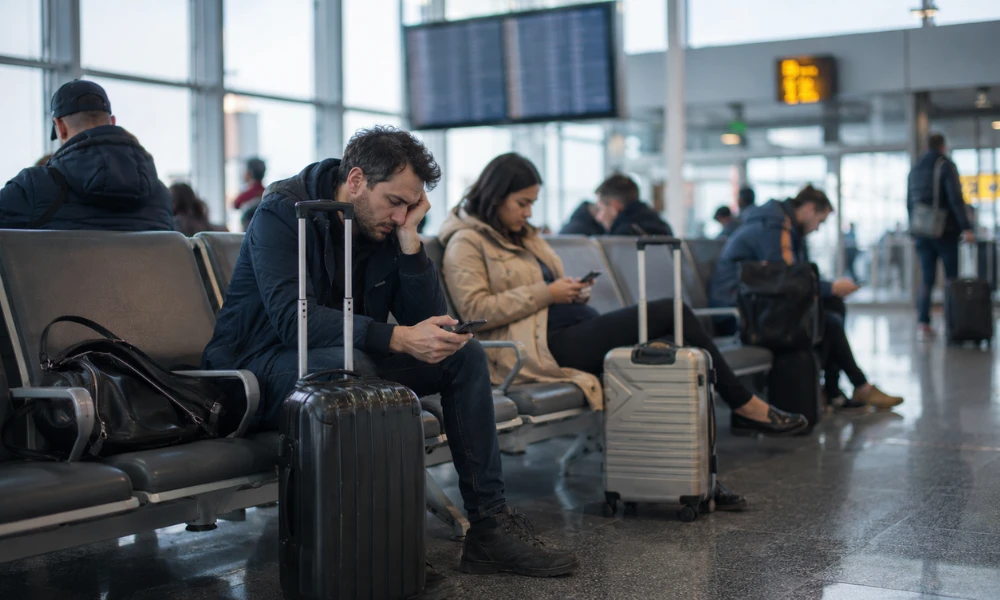
The fixed amount is based mainly on flight distance and, for long-haul journeys, the final arrival delay. It is not calculated from the ticket price. A low-cost ticket can therefore produce the same fixed payment as a more expensive ticket on the same disrupted flight.
| Flight distance | Final arrival delay | Potential compensation per passenger |
|---|---|---|
| Up to 1,500km | 3 hours or more | £220 |
| 1,500km to 3,500km | 3 hours or more | £350 |
| More than 3,500km | Between 3 and 4 hours | £260 |
| More than 3,500km | More than 4 hours | £520 |
The website’s compensation calculator can help match the route distance to the relevant compensation band.
These amounts apply per eligible passenger. The compensation is based on the disruption rather than the amount originally paid for the ticket.
What assistance should the airline provide?
Compensation is not the only protection. The right to care can apply even when the disruption is caused by extraordinary circumstances and no fixed compensation is due.
Care normally begins after:
- Two hours for flights under 1,500km
- Three hours for flights between 1,500km and 3,500km
- Four hours for flights over 3,500km
The airline should provide reasonable food and drink, access to communication and, when an overnight stay becomes necessary, suitable accommodation and transport between the airport and the accommodation.
When the airline does not provide assistance, passengers should keep receipts for reasonable expenses. Luxury hotels, premium meals and alcohol may not be reimbursed.
If a delay reaches at least five hours and you decide not to travel, you can normally request a refund for the unused flight.
When extraordinary circumstances prevent compensation
UK261 flight compensation is usually unavailable when the airline proves that extraordinary circumstances caused the disruption and that reasonable measures could not have avoided it.
Likely examples include severe weather that makes flying unsafe, air traffic control restrictions, airport or border-force strikes, security threats, political unrest, sabotage and certain hidden manufacturing defects.
Ordinary technical faults are not automatically extraordinary. Routine operational problems, aircraft rotation issues and preventable staffing failures may remain within the airline’s responsibility.
Every claim depends on its specific evidence, so an airline should explain clearly why it believes the exception applies.
The UK Civil Aviation Authority’s flight-delay guidance gives official information about care, compensation amounts and escalation.
Could your disrupted UK flight qualify?
Was your flight seriously delayed, cancelled at short notice or affected by a missed connection? A brief review of the route, airline, arrival time and stated reason may clarify your position, and help with a possible UK261 claim is available when the circumstances are unclear.
How to make an EU261 compensation UK claim in 2026
Although the search phrase EU261 compensation UK remains popular, a claim for a flight departing the UK should normally refer to UK passenger-rights law.
Accurate details are more important than legal jargon, but identifying UK261 helps prevent confusion.
A practical claim process is:
- Collect the flight number, travel date, booking reference and passenger names.
- Record the scheduled and actual arrival times at the final destination.
- Save boarding passes, booking confirmations, airline messages, photographs and receipts.
- Ask the airline to confirm the precise reason for the delay or cancellation.
- Submit the claim to the operating airline and state the compensation and expenses requested.
- Keep copies of all forms, emails and supporting documents.
Compensation and expenses may need separate submissions. Fixed compensation covers the inconvenience caused by an eligible disruption, while reimbursement covers reasonable money spent because the airline did not provide required care.
The flight compensation FAQs also explain the claim service, fees and common passenger questions.
What evidence strengthens a flight delay compensation UK claim?
Good records reduce arguments about timing, eligibility and expenses. Useful evidence includes the original itinerary, boarding pass, baggage receipt, screenshots from the airline app, airport departure-board photographs and written delay notifications.
Keep itemised receipts for meals, transport and accommodation. A bank statement alone may show that money was spent but not what was purchased, so the original receipt is preferable.
Ask the airline for the disruption reason in writing. General phrases such as “operational reasons” may be too vague to establish whether the event was extraordinary. If the explanation changes, retain every version.
For a connecting itinerary, keep documents showing that all flights were part of the same reservation. This can be important when proving the delay at the final destination.
What happens if the airline rejects the claim?
A rejection is not always the end of the process. Read the airline’s explanation and compare it with the facts, especially where it relies on extraordinary circumstances.
If the airline belongs to an approved Alternative Dispute Resolution scheme, the complaint may be escalated there after the airline issues its final response. If the airline is not an ADR member, the Civil Aviation Authority’s Passenger Advice and Complaints Team may be relevant.
Escalation is also possible when the airline has not provided a satisfactory response within eight weeks. Court action may be available, but limitation periods and procedures depend on the part of the UK involved.
Claims can generally be pursued for up to six years in England, Wales and Northern Ireland, while Scotland normally has a five-year limitation period. It is still sensible to act earlier because flight records and evidence become harder to obtain over time.
Common questions about EU261 compensation UK rules
Does UK261 apply to a non-UK airline?
Yes. Every flight departing from a UK airport is covered, even when the airline is based outside the UK or EU.
Is compensation paid for a two-hour delay?
Usually not as fixed delay compensation. The arrival delay generally needs to exceed three hours, although the right to food, drink and communication may begin earlier depending on flight distance.
Can I claim when bad weather caused the delay?
Fixed compensation is unlikely when genuinely unsafe weather directly caused the disruption. The airline’s duty of care can still apply while you wait.
Can I claim if the ticket was inexpensive?
Yes. Flight delay compensation UK amounts are fixed by distance and delay rather than the ticket price.
Can a package-holiday passenger claim?
Potentially, yes. The claim is normally made against the operating airline, while separate package-travel rights may apply against the organiser.
Is accepting a voucher the same as accepting compensation?
Not necessarily. Read the conditions carefully before accepting a voucher, miles or travel credit, because the airline may ask you to settle or waive part of the claim.
What UK passengers should remember in 2026
Brexit did not remove compensation rights for flights leaving the UK. It changed the legal framework and terminology.
In 2026, every flight departing from a UK airport remains within UK passenger-rights legislation, regardless of the airline or destination.
The basic test is whether the disruption meets the timing rules, whether the operating airline was responsible and whether extraordinary circumstances genuinely apply.
UK261 flight compensation can reach £520 per passenger, while separate care and reimbursement rights may apply even when fixed compensation is unavailable.
The phrase EU261 compensation UK is useful for finding information, but UK261 is normally the correct framework for a UK departure. Checking the route, final arrival delay, airline and disruption reason gives the clearest indication of whether a claim is worth pursuing.
claim now
Have you had a flight delay, missed connection, cancelled flight or have been denied boarding in the last 6 years? If so try our free flight checker to see how much you may be entitled to in compensation for you AND your fellow travellers.
Start a Claim