- Home
- Make a claim
- Airlines
- Adria Airways
- Aegean Airlines
- Aer Lingus
- Aeroflot Russian Airlines
- AeroMexico
- Air Albania
- Air Algerie
- Air Arabia
- Air Austral
- Air Baltic
- Air Canada
- Air China
- Air Corsica
- Air Dolomiti
- Air Europa
- Air France
- Air India
- Air Malta
- Air Mauritius
- Air Moldova
- Air New Zealand
- Air Philippines
- Air Senegal International
- Air Serbia
- Air Transat
- Alitalia Express
- All Nippon Airways
- American Airlines
- Arkia Israel Airlines
- ASL Airlines
- Atlantic Airways
- Aurigny Air Services
- Austrian Airlines
- Avianca
- Azerbaijan Airlines
- Azores - SATA International
- Biman Bangladesh Airlines
- Blue Air
- Blue Islands
- Bluebird Airways
- BMI Regional
- British Airways
- Brussels Airlines
- Brussels International Airlines
- Bulgaria Air
- Buzz Stansted
- Cathay Pacific
- China Airlines
- China Eastern Airlines
- Continental Airlines
- Corendon Airlines
- Croatia Airlines
- Cyprus Airways
- Czech Airlines
- Delta Air Lines
- Eastern Airways
- easyJet
- Egyptair
- El Al
- Emirates
- Envoy Air
- Ethiopian Airlines
- Etihad Airways
- Eurowings
- Finnair
- Fly One
- Flybe
- Flyr
- Gol Transportes Areos
- Gulf Air
- Helvetic Airways
- HiSky
- Iberia Airlines
- Iberia Express
- Icelandair
- Iran Air
- Iraqi Airways
- ITA Airways
- Japan Airlines
- Jazeera Airways
- Jet Airways
- Jet2
- JetBlue
- Juneyao Air
- Kenya Airways
- KLM
- Korean Air
- Kuwait Airways
- LATAM Airlines
- Lauda Europe
- Loganair
- LOT Polish Airlines
- Lufthansa
- Luxair
- Malaysia Airlines
- Norse
- Norwegian
- Nouvelair Tunisie
- Pakistan International Airlines
- Pegasus Airlines
- Play Airlines
- Qantas
- Qatar Airways
- Rossiya Russian Airlines
- Royal Air Maroc
- Ryanair
- SAS
- Saudia
- Scoot
- Silk Way Airlines
- Singapore Airlines
- Sky Express
- South African Airways
- SriLankan Airlines
- SunExpress
- Sunwing Airlines
- Surinam Airways
- Swiss International
- TAP Air Portugal
- Thai Airways
- Transavia
- TUI
- Tunisair
- Turkish Airlines
- Turkmenistan Airlines
- Ukraine International Airlines
- Vietnam Airlines
- Virgin Atlantic
- Vueling Airlines
- WestJet
- Wideroe
- Wizz Air
- Airports
- FAQ's
- Compensation Calculator
- Recent Flight Delays
- Blog
- About Us
- Contact Us
Can you claim compensation if your flight was delayed because of a strike?
Date: 06 JULY 26
Flight delay strike compensation is one of the most searched passenger rights questions — and one of the most misunderstood. The short answer is: it depends entirely on whose employees went on strike. Get that distinction right, and you could be owed up to £520 per person. Get it wrong, and you may spend weeks chasing a claim that was never going to succeed.
This guide explains clearly when a strike entitles you to compensation, when it does not, and what rights you still have even when financial compensation is off the table.
The rule that determines everything: who was on strike?
Under UK and EU passenger rights law — specifically the retained version of EU Regulation 261/2004 that still applies in the UK — the key question when a strike disrupts your flight is whether the striking workers were employed by your airline.
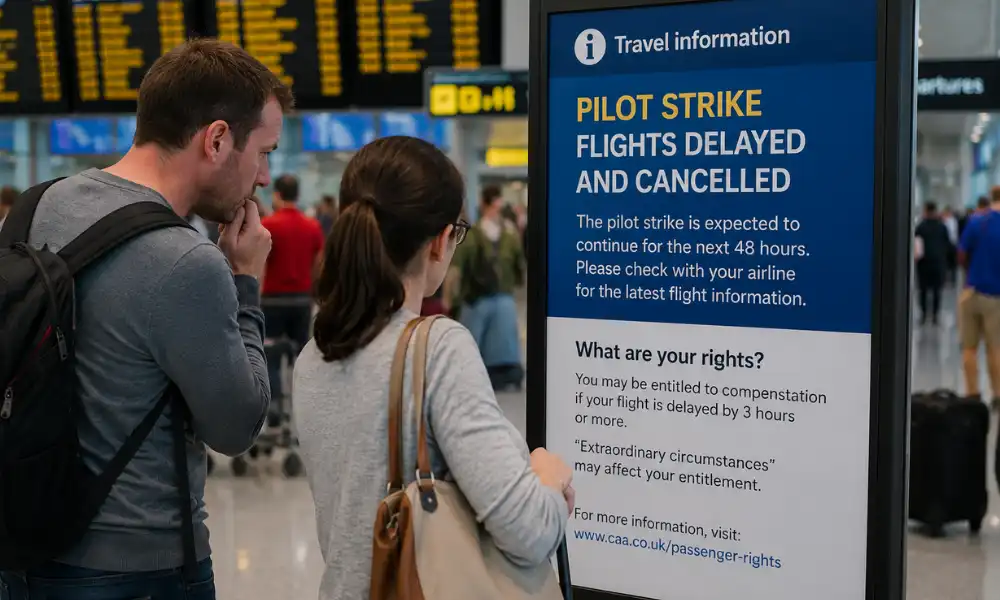
If the airline's own staff went on strike — pilots, cabin crew, ground crew employed directly by the carrier — then the disruption is not considered an extraordinary circumstances flight event. In that situation, the strike is treated as something within the airline's control, and you are entitled to compensation if your flight was delayed by three hours or more, or cancelled.
If the strike was by workers outside the airline's control — air traffic controllers, airport security, border police, or third-party baggage handlers — then it is treated as an extraordinary circumstances flight event. In that case, the airline is generally not required to pay financial compensation, even if your delay was lengthy.
What counts as an extraordinary circumstances flight event?
The term 'extraordinary circumstances' is used in the regulation to describe events that are outside the airline's control and could not have been avoided even if all reasonable measures had been taken. When a disruption is classified as extraordinary, the airline is exempt from paying the standard financial compensation.
Strikes by third parties are the most common example. In practice, the following types of industrial action are generally treated as extraordinary circumstances under UK and EU passenger rights rules:
- Air traffic control (ATC) strikes. When air traffic controllers walk out, airlines cannot operate flights in the affected airspace. Courts consistently treat ATC strike flight delay as a genuine extraordinary circumstance because airlines have no control over ATC staffing decisions.
- Airport security strikes. If the airport's own security staff — not employed by the airline — go on strike and prevent passengers from being processed, the resulting delay or cancellation falls outside the airline's responsibility.
- Border control and immigration strikes. Industrial action by government-employed border force personnel can ground flights or create severe departure delays that airlines cannot be expected to manage.
- Third-party ground handling strikes. Some airports use independent ground handling companies for baggage loading, refuelling, and other services. If those workers strike, the resulting disruption may qualify as extraordinary circumstances.
It is worth noting that even where a disruption qualifies as extraordinary circumstances, airlines are still required to take all reasonable measures to minimise the impact. An airline that makes no effort to reroute passengers or seek alternative solutions may still face scrutiny even if the original disruption was genuinely beyond its control.
When are airline strikes NOT extraordinary circumstances?
The European Court of Justice has ruled clearly that a strike by an airline's own employees does not automatically qualify as an extraordinary circumstances flight event. The reasoning is that airlines, as employers, have some influence over their own industrial relations — and therefore some responsibility to manage or anticipate workforce disputes.
In a key ruling, the ECJ confirmed that internal strike action by airline staff can entitle passengers to compensation, particularly where the strike is linked to the airline's own internal decisions about pay, rosters, or working conditions. The 2021 ECJ judgment further confirmed that union strikes by airline staff generally do not fall within the extraordinary circumstances exemption.
In practical terms, this means that if your flight was delayed or cancelled because pilots, cabin crew, or other airline employees were on strike, you may well be entitled to flight delay strike compensation of between £220 and £520 per person depending on the distance of the route.
ATC strikes and France: a special case worth knowing
France and Spain are the two countries most frequently associated with ATC strike flight delay disruption for UK travellers — particularly during the summer months. French air traffic controllers have a long history of industrial action, and their strikes routinely affect flights that are only routing over French airspace on the way to other destinations.
A common situation: your flight from the UK to Spain is delayed or cancelled because of a French ATC strike. The aircraft never even lands in France, but it cannot fly through French airspace while controllers are walking out. In this case, the disruption is treated as an extraordinary circumstances flight event, and the airline is typically not required to pay financial compensation.
This can feel deeply unfair to passengers who had no connection to France whatsoever. But the legal position is consistent: ATC strikes are classified as beyond the airline's control regardless of which country's controllers are involved or which route the flight was taking.
The scale of disruption that ATC strikes cause is significant. In 2025 alone, French ATC strikes in July caused over 1,400 cancellations per day at peak, affecting more than a million passengers over the course of the action. That is a large number of travellers who had no entitlement to flight delay strike compensation — but who did retain other important rights.
What rights do you have when the strike IS extraordinary circumstances?
Even when an airline is not required to pay financial flight delay strike compensation because the disruption was caused by extraordinary circumstances, you still have significant rights under UK and EU passenger rights rules. These rights apply regardless of the cause of the delay.
Right to care and assistance means that if your departure is delayed by two hours or more (for flights under 1,500km), three hours or more (for flights between 1,500km and 3,500km), or four hours or more (for longer flights), the airline must provide:
- Meals and refreshments appropriate to the waiting time.
- Two free phone calls, emails, or fax messages.
- Hotel accommodation and transport to and from it if an overnight stay becomes necessary.
Right to a refund or rebooking: if your flight is cancelled or delayed by five hours or more and you decide not to travel, you are entitled to a full refund of your ticket price. Alternatively, the airline must offer you re-routing to your destination as early as possible, or at a later date at your convenience.
These rights apply even during ATC strikes, even during French ATC action that affects UK-departing flights, and even when the airline correctly classifies the disruption as an extraordinary circumstances flight event. If an airline fails to provide care and assistance during a qualifying delay, you can claim those costs back.
If your airline refused to provide meals, accommodation, or rebooking during a strike-related delay, our passenger rights FAQ explains exactly what you are entitled to and how to recover those costs.
How to check whether you can claim — and what to do next
Before assuming your strike-related delay means no compensation, it is always worth checking. Airlines sometimes attribute delays broadly to 'strike action' or 'ATC' without specifying the precise cause. If the disruption was actually caused by the airline's own staff — or if the airline has misclassified an internal issue as extraordinary circumstances — you may have a valid flight delay strike compensation claim.
Here is what to do if you were delayed due to a strike:
1. Get the reason for the delay in writing. Ask the airline to confirm in writing which workers were on strike, who employed them, and why this constitutes an extraordinary circumstances flight event under UK passenger rights rules.
2. Check what actually happened. ATC strikes are public events covered by aviation news and government communications. If there was no reported ATC or external strike on the date of your flight, the airline's claim is worth challenging.
3. Use our compensation calculator. Enter your flight details and we will assess whether your delay qualifies for compensation and calculate the amount you could be owed.
4. Submit a claim if it qualifies. If the delay was caused by the airline's own staff, you have up to six years to make a claim under UK law.
Our free flight compensation calculator gives you an instant indication of whether your claim is likely to succeed and what it could be worth — in under two minutes.
What about cancelled flights caused by strikes?
The same rules apply to cancelled flights as to delayed ones. If your flight was cancelled because of a strike by the airline's own employees, you are entitled to financial compensation as long as you were given less than 14 days' notice of the cancellation.
If the cancellation was due to extraordinary circumstances — including an ATC strike flight delay so severe that the whole schedule collapsed — financial compensation is not owed. But you are still entitled to a full refund, re-routing, and care and assistance at the airport.
If your flight was cancelled and you are unsure about your entitlement, our cancelled flight claim page explains your options clearly and lets you start a claim immediately.
claim now
Have you had a flight delay, missed connection, cancelled flight or have been denied boarding in the last 6 years? If so try our free flight checker to see how much you may be entitled to in compensation for you AND your fellow travellers.
Start a Claim