- Home
- Make a claim
- Airlines
- Adria Airways
- Aegean Airlines
- Aer Lingus
- Aeroflot Russian Airlines
- AeroMexico
- Air Albania
- Air Algerie
- Air Arabia
- Air Austral
- Air Baltic
- Air Canada
- Air China
- Air Corsica
- Air Dolomiti
- Air Europa
- Air France
- Air India
- Air Malta
- Air Mauritius
- Air Moldova
- Air New Zealand
- Air Philippines
- Air Senegal International
- Air Serbia
- Air Transat
- Alitalia Express
- All Nippon Airways
- American Airlines
- Arkia Israel Airlines
- ASL Airlines
- Atlantic Airways
- Aurigny Air Services
- Austrian Airlines
- Avianca
- Azerbaijan Airlines
- Azores - SATA International
- Biman Bangladesh Airlines
- Blue Air
- Blue Islands
- Bluebird Airways
- BMI Regional
- British Airways
- Brussels Airlines
- Brussels International Airlines
- Bulgaria Air
- Buzz Stansted
- Cathay Pacific
- China Airlines
- China Eastern Airlines
- Continental Airlines
- Corendon Airlines
- Croatia Airlines
- Cyprus Airways
- Czech Airlines
- Delta Air Lines
- Eastern Airways
- easyJet
- Egyptair
- El Al
- Emirates
- Envoy Air
- Ethiopian Airlines
- Etihad Airways
- Eurowings
- Finnair
- Fly One
- Flybe
- Flyr
- Gol Transportes Areos
- Gulf Air
- Helvetic Airways
- HiSky
- Iberia Airlines
- Iberia Express
- Icelandair
- Iran Air
- Iraqi Airways
- ITA Airways
- Japan Airlines
- Jazeera Airways
- Jet Airways
- Jet2
- JetBlue
- Juneyao Air
- Kenya Airways
- KLM
- Korean Air
- Kuwait Airways
- LATAM Airlines
- Lauda Europe
- Loganair
- LOT Polish Airlines
- Lufthansa
- Luxair
- Malaysia Airlines
- Norse
- Norwegian
- Nouvelair Tunisie
- Pakistan International Airlines
- Pegasus Airlines
- Play Airlines
- Qantas
- Qatar Airways
- Riyadh Air
- Rossiya Russian Airlines
- Royal Air Maroc
- Ryanair
- SAS
- Saudia
- Scoot
- Silk Way Airlines
- Singapore Airlines
- Sky Express
- South African Airways
- SriLankan Airlines
- SunExpress
- Sunwing Airlines
- Surinam Airways
- Swiss International
- TAP Air Portugal
- Thai Airways
- Transavia
- TUI
- Tunisair
- Turkish Airlines
- Turkmenistan Airlines
- Ukraine International Airlines
- Vietnam Airlines
- Virgin Atlantic
- Vueling Airlines
- WestJet
- Wideroe
- Wizz Air
- Airports
- FAQ's
- Compensation Calculator
- Recent Flight Delays
- Blog
- About Us
- Contact Us
Can you claim compensation if you accept a replacement flight?
Date: 13 JULY 26
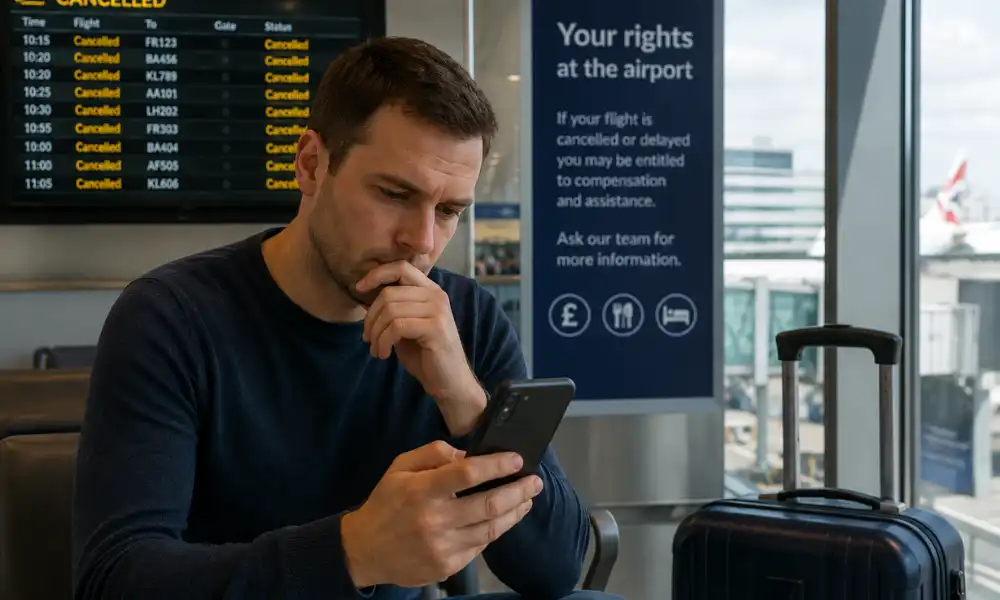
Replacement flight compensation is one of the most confusing areas of UK passenger rights — and airlines are not always in a hurry to make it clearer. Many passengers assume that by accepting a seat on a new flight, they have given up any right to a financial payout. That is not how the law works.
Accepting a replacement flight after a cancellation does not automatically cancel your cancelled flight rights. Whether you can still claim compensation depends on how much notice you were given, how the timing of your replacement flight compares to the original, and where your flight departed from. This guide explains exactly how it works.
What happens to your rights when a flight is cancelled?
Under UK passenger rights law — the retained version of EU Regulation 261/2004 — when your flight is cancelled, you are immediately entitled to two things: a choice between a full flight cancellation refund or a replacement flight to your destination, and care and assistance while you wait.
The crucial point is that these two entitlements are separate from financial compensation. Getting a replacement flight does not extinguish your right to claim a cash payout on top. Your cancelled flight rights include both the rebooking and the compensation — they are not an either/or.
What determines whether you can claim financial compensation on top of your replacement flight is a different set of rules — specifically, how much notice you received and how the timing of the replacement flight compares to your original booking.
Quick Answer
Yes — accepting a replacement flight does not waive your right to replacement flight compensation. Whether you are owed money depends on how much notice you had and how late the replacement got you to your destination.
The 14-day rule: when compensation applies
The most important factor in determining whether you are entitled to replacement flight compensation is how much advance notice the airline gave you of the cancellation.
If you received less than 14 days' notice that your flight was cancelled, you may be entitled to financial compensation — provided the cancellation was the airline's fault, not the result of extraordinary circumstances like severe weather or an air traffic control strike. This entitlement applies regardless of whether you took a replacement flight or chose a flight cancellation refund instead.
If you received 14 days' notice or more, financial compensation does not apply. The airline is still required to offer you a refund or replacement flight and to provide care and assistance, but the cash payment threshold is not triggered.
How the replacement flight timing affects your compensation
Even within the under-14-days window, not every cancelled flight automatically results in a full compensation payout. The amount you can claim — and whether you can claim at all — also depends on how the timing of your replacement flight compares to your original booking.
If you received less than 7 days' notice
Where you were told about the cancellation less than 7 days before your original departure date, you can claim full replacement flight compensation unless both of the following are true: your replacement flight departed no more than one hour before your original departure time, and your replacement flight arrived less than two hours later than your original arrival time. If both conditions are met, no financial compensation is owed.
In any other situation — including if you arrive more than two hours late — you are entitled to compensation of £220, £350, or £520 per person, depending on the distance of the route.
If you received between 7 and 14 days' notice
Where notice was given between 7 and 14 days before departure, the rules are slightly different. Compensation is not owed if your replacement flight departed no more than two hours before your original departure, and arrived at your destination less than four hours after your original scheduled arrival.
If the replacement gets you to your destination more than the relevant threshold late — two hours for short-haul, three hours for medium-haul, four hours for long-haul — you are entitled to compensation. The exact amount varies depending on how late you arrived and the distance of the flight.
What are the compensation amounts?
The amount of replacement flight compensation you can claim is set by regulation and does not depend on the price you paid for your ticket. The figures are:
- £220 per person for short-haul flights of under 1,500km.
- £350 per person for medium-haul flights between 1,500km and 3,500km.
- £260 per person for long-haul flights of over 3,500km where the delay to arrival was less than four hours.
- £520 per person for long-haul flights of over 3,500km where the delay to arrival was four hours or more.
These figures can be reduced by 50% in certain circumstances where the replacement flight gets you to your destination close to the original arrival time, but the full amounts apply where the delay is significant. All figures are per passenger, so a family of four could be looking at a combined claim of over £2,000 on a long-haul route.
Do you lose your rights if you sign anything at the airport?
This is one of the most common concerns passengers have when accepting a replacement flight — and a genuinely important one. Airlines sometimes present passengers with forms, vouchers, or electronic confirmations at the desk that appear to require them to acknowledge the rebooking in exchange for the new boarding pass.
Simply accepting a new boarding pass or signing a rebooking confirmation does not waive your cancelled flight rights to financial compensation. Under UK law, your right to compensation cannot be signed away in exchange for a replacement flight — accepting the rebooked seat and claiming financial compensation are both available to you.
Where passengers can genuinely lose their rights is if they voluntarily accept an alternative benefit — such as a travel voucher or upgrade — in exchange for explicitly waiving their compensation claim. Airlines must make it very clear that this is what you are agreeing to. If you were offered a voucher without being told it was in lieu of your legal entitlement, you may still be able to claim.
If you are unsure whether anything you signed at the airport affected your claim, our passenger rights FAQ covers this question in detail.
What if you accepted a flight cancellation refund instead?
If you chose a full flight cancellation refund rather than a replacement flight, your entitlement to compensation works the same way. The refund and the financial compensation are separate. Choosing to take your money back rather than travel does not extinguish your right to the cash payout — provided the other conditions are met.
Where passengers sometimes lose out here is if they make alternative travel arrangements themselves without going through the airline — booking a new flight independently and then trying to claim the cost back alongside compensation. The reimbursement of independently booked alternative flights is a separate and more complex matter, and may not always be recoverable. Compensation for the original cancelled flight, however, remains available under the same rules.
Does it matter which airline operated the replacement flight?
Your compensation claim is against the airline that operated your original cancelled flight — not the airline that operated your replacement. If the airline put you on a partner carrier's flight to get you to your destination, the claim still goes to the airline that cancelled your booking.
This is relevant where airlines use codeshare arrangements or partner airlines to fulfil rebooking obligations. Always direct your claim to the operating carrier of the cancelled flight, even if the replacement was operated by a completely different airline.
How far back can you claim?
Under UK law, passengers have up to six years to make a replacement flight compensation claim for cancelled flights. This means if you were cancelled and rebooked on a replacement flight in the last six years and never claimed, you may still be able to do so now.
Airlines count on passengers not knowing this time window. A significant proportion of eligible claims are never submitted, either because passengers assumed they had no rights after accepting the replacement, or because the airline's initial refusal put them off pursuing it further.
Checking whether a past cancellation entitles you to compensation takes only a few minutes using our cancelled flight claim tool. If the flight was within the last six years and the conditions are met, it is worth checking even if the airline told you at the time that you were not entitled to anything.
What to do if the airline says you waived your rights
Airlines sometimes push back on claims by arguing that passengers waived their compensation rights when they accepted the replacement flight. In most cases, this argument does not stand up. Accepting a new boarding pass is not a waiver of your legal rights.
If an airline refuses your claim on this basis, the next steps are to escalate the complaint to an alternative dispute resolution (ADR) scheme that the airline is a member of, or to the Civil Aviation Authority. In the UK, airlines are required to be members of an approved ADR scheme, and these schemes can compel airlines to pay valid claims without the need for court proceedings.
We handle this entire process on your behalf on a No Win, No Fee basis. If the airline has refused a valid claim, we will pursue it through the appropriate channels.
claim now
Have you had a flight delay, missed connection, cancelled flight or have been denied boarding in the last 6 years? If so try our free flight checker to see how much you may be entitled to in compensation for you AND your fellow travellers.
Start a Claim